Introduction to AI-Powered Virtual Try-On Technology
The way people explore and purchase fashion products online is changing with the development of Artificial Intelligence (AI), Computer Vision and Augmented Reality (AR). Traditional online shopping allows customers to view product images, but it does not always provide an accurate idea of how accessories or fashion products will look on them. Virtual Try-On technology addresses this limitation by allowing users to experience digital products through a live camera.
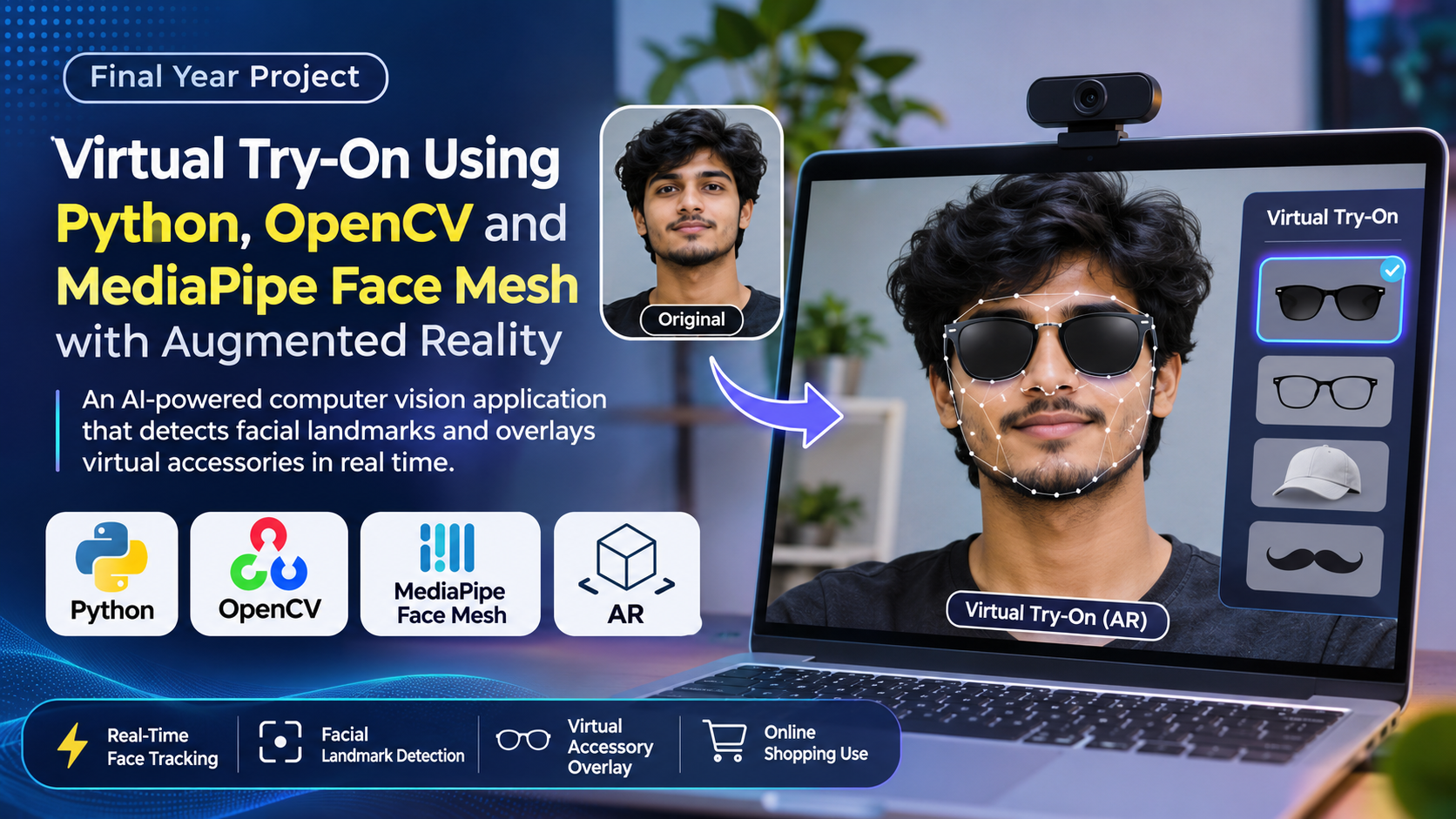
The Virtual Try-On Using Python, OpenCV, MediaPipe Face Mesh and Augmented Reality project introduces an interactive computer vision application that detects facial landmarks and overlays virtual accessories onto a user's face in real time. By combining Python-based image processing with facial landmark detection, the application creates an engaging experience without requiring users to physically wear the selected accessories.
This project demonstrates how AI-powered computer vision can improve digital shopping experiences, interactive applications and next-generation fashion technology. It also provides a practical implementation of real-time face tracking, image processing and augmented reality concepts.
Key Features & Benefits
How Does the Virtual Try-On System Work?
The virtual try-on application uses a webcam to capture live video frames and processes them using Python and OpenCV. MediaPipe Face Mesh identifies important facial landmarks, including the eyes, nose, lips and facial boundaries. These landmarks help determine the position, size and orientation of virtual accessories.
The system follows a continuous image processing workflow:
Camera Initialization: The webcam captures live video frames from the user.
Face Detection: MediaPipe Face Mesh identifies the user's face in the captured frame.
Facial Landmark Extraction: Important facial points are detected to understand the face's structure.
Accessory Position Calculation: The application calculates suitable positions for virtual accessories using facial landmarks.
Augmented Reality Overlay: OpenCV processes and overlays transparent accessory images onto the live video.
Real-Time Display: The modified video is displayed continuously, allowing users to observe the virtual appearance.
The application updates the accessory position whenever the user moves their face, creating an interactive virtual fitting experience.
Implementation Guide
Technologies Used in the Virtual Try-On Project
The project combines multiple technologies to build a real-time augmented reality application.
Python: Python serves as the primary programming language for developing the application and integrating computer vision functionalities.
MediaPipe Face Mesh: MediaPipe Face Mesh detects facial landmarks and provides detailed facial tracking information for accurate accessory placement.
Augmented Reality (AR): AR techniques combine virtual objects with live camera footage, allowing users to visualize digital accessories on their faces.
NumPy: NumPy supports efficient numerical operations and image array manipulation during the processing pipeline.
Webcam Integration: The camera provides real-time facial video input, enabling continuous tracking and visualization.
The integration of these technologies creates a lightweight and interactive computer vision solution for virtual product visualization.
Technical Specifications
Key Features and Real-World Applications
The AI-based virtual try-on application offers several useful capabilities for modern digital experiences.
Key Features
Real-time face detection and facial landmark tracking.
Live webcam-based virtual try-on functionality.
Facial landmark-based accessory positioning.
Augmented reality object overlay.
Interactive visualization of virtual accessories.
Dynamic adjustment based on facial movement.
Python-based computer vision implementation.
Integration of MediaPipe and OpenCV technologies.
Real-World Applications
Online Fashion Shopping: Customers can visualize selected accessories before making purchasing decisions.
Eyewear Industry: Virtual glasses try-on systems can help customers preview different frame styles.
Beauty and Cosmetics: AR-based applications can demonstrate virtual makeup and beauty products.
E-Commerce Platforms: Online retailers can integrate virtual product visualization to improve customer engagement.
Fashion Technology: Digital fitting applications can support interactive fashion experiences.
Educational Projects: This implementation provides practical knowledge of computer vision, image processing and augmented reality development.
Conclusion & Next Steps
Conclusion and Future Scope
The Virtual Try-On Using Python, OpenCV, MediaPipe Face Mesh and Augmented Reality project demonstrates how computer vision and augmented reality can be combined to create an interactive digital fitting experience. By identifying facial landmarks and positioning virtual accessories on live camera frames, the system provides a practical approach to real-time virtual product visualization.
This project highlights the importance of AI-powered technologies in transforming online shopping, fashion applications and interactive digital platforms.
In the future, the system can be enhanced with advanced 3D accessory models, deep learning-based facial analysis, improved lighting adaptation, mobile application integration and AI-powered product recommendations. Integration with e-commerce platforms could also enable customers to explore products virtually before purchasing them.
Students and developers can use this project as a learning foundation for Python programming, OpenCV, MediaPipe, facial landmark detection, augmented reality and real-time computer vision application development.
Develop Your Computer Vision Project with Aislyn Technologies
Aislyn Technologies provides project development support and technical guidance for students and developers working on Python, Artificial Intelligence, Machine Learning, Computer Vision, IoT and Embedded Systems projects.
Contact Aislyn Technologies
Aislyn Technologies – Bangalore
Phone: +91 97395 94609
Email: info@aislyntech.com
Website: https://aislyn.in
Contact us today to start building your Python, Artificial Intelligence or Computer Vision project with expert technical support!