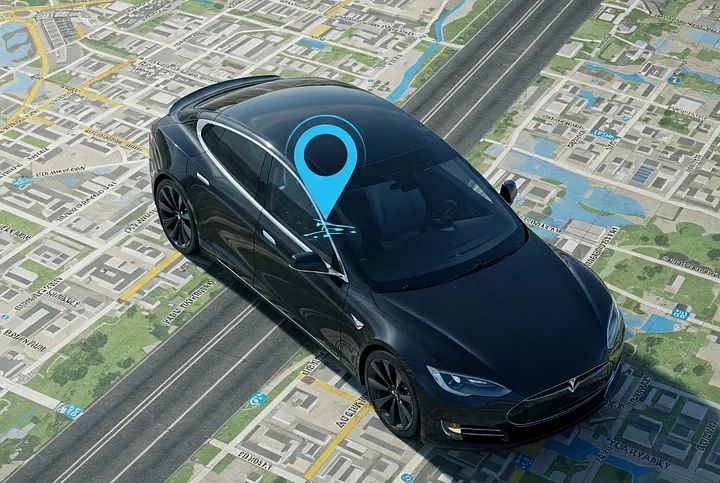
The main objective of this project is to develop an embedded vehicle monitoring system that combines GPS tracking and GSM communication for location reporting and security management.
The system is designed around a vehicle-mounted electronic unit that collects location information and communicates with an authorized user.
Main project objectives:
Develop a GPS-based vehicle tracking application.
Obtain vehicle location coordinates.
Transmit location information using GSM communication.
Display vehicle location through a map-based application.
Maintain vehicle tracking and event history.
The project demonstrates the integration of embedded hardware, satellite navigation, wireless communication, and vehicle security technologies.
Key Features & Benefits
Key Features of the GSM and GPS Vehicle Tracking System
The proposed system can include several modules for vehicle location monitoring and security management.
1. GPS-Based Location Tracking
The GPS receiver obtains geographical coordinates using signals from navigation satellites. The microcontroller processes the location information for transmission and display.
2. GSM Communication
A GSM module allows the vehicle unit to communicate with the registered user through SMS or other supported cellular communication methods.
3. Remote Location Updates
The system can send vehicle location information to an authorized user. A mobile application or web dashboard can display the coordinates on a digital map.
4. Vehicle Movement Monitoring
The application can monitor available GPS information and detect changes in vehicle position. Additional motion sensors can be integrated to identify selected movement events.
5. Security Notifications
The system can generate alerts for configured events, such as unauthorized movement, unexpected ignition activity, or power disconnection.
6. Remote Locking and Immobilization Interface
An authorized user interface can request a security-related control operation. Any immobilization feature must be implemented through a manufacturer-approved, safety-rated mechanism and must never disable a moving vehicle or interfere with steering, braking, or other essential functions.
7. Location History
Vehicle coordinates and timestamps can be stored in a database to display previous travel information and movement history.
8. Mobile or Web Dashboard
A monitoring interface can display vehicle location, communication status, GPS information, and security notifications.
Implementation Guide
Technologies and Hardware Components Used
The project combines embedded controllers, satellite navigation, cellular communication, and vehicle monitoring components.
Arduino / ESP32: Acts as the main controller for collecting GPS data, processing commands, and managing communication with connected modules.
GPS Module: Modules such as NEO-6M or compatible GPS receivers can obtain geographical coordinates, speed information, and time data.
GSM Module: Modules such as SIM800L or other compatible cellular modules can send SMS notifications and support communication with the monitoring application. Network compatibility must be checked before selecting the module.
Relay / Control Interface: A suitable isolated control interface can be used for supported low-voltage demonstration operations. Vehicle immobilization requires an independently engineered and vehicle-compatible safety mechanism.
Vibration / Motion Sensor: Can detect selected physical disturbances or movement events around the vehicle.
Power Supply Circuit: Provides regulated power to the embedded controller, GPS receiver, and communication module.
LCD / OLED Display: Displays location information and system status locally.
Python / Flask: Can be used to develop a backend application for receiving location data and managing vehicle records.
MySQL: Stores vehicle information, GPS coordinates, event records, and tracking history.
Google Maps / Mapping Interface: Can display vehicle coordinates and location history on a map when the application integrates a suitable mapping service.
Technical Specifications
System Architecture and Implementation Process
The proposed system follows a workflow involving GPS data collection, location processing, cellular communication, and remote monitoring.
Step 1: Hardware Initialization
The microcontroller initializes the GPS receiver, GSM module, and connected sensors. It checks the availability of the required hardware components.
Step 2: GPS Data Acquisition
The GPS receiver obtains location information from satellite signals. The system reads latitude, longitude, and other available navigation information.
Step 3: Location Data Processing
The microcontroller processes the received GPS information and prepares it for transmission. Invalid or unavailable GPS readings should be identified before they are shared.
Step 4: GSM Communication
The GSM module sends the vehicle location and selected status information to an authorized user or connected backend service.
Step 5: Remote Monitoring
The monitoring application receives the transmitted data and displays the vehicle's location on a map. The user can review the latest available coordinates and communication status.
Step 6: Security Event Detection
The system monitors configured inputs, such as vibration or ignition status, and identifies events that may require attention.
Step 7: Notification Generation
When a configured security event occurs, the application sends an SMS or dashboard notification to the registered user.
Step 8: Authorized Security Control
If a remote immobilization function is included, the control request must pass authentication and independent safety checks. The implementation should only permit safe immobilization under approved stationary conditions and should provide a reliable recovery method.
This architecture demonstrates how GPS and GSM can be integrated into an embedded vehicle monitoring solution.
Conclusion & Next Steps
Conclusion
The Vehicle Tracking and Locking System Based on GSM and GPS demonstrates how embedded systems and wireless communication can be used to develop a vehicle monitoring and security solution. By combining GPS location acquisition, GSM communication, security event detection, and remote monitoring, the project provides a practical foundation for intelligent vehicle tracking.
The project is suitable for students interested in embedded systems, IoT, GPS navigation, cellular communication, and automotive electronics. With additional capabilities such as geofencing, cloud integration, mobile applications, and safe vehicle security controls, the system can be extended into a more comprehensive vehicle tracking platform.
























.jpeg)
