ABSTRACT
The proposed project focuses on the development of an intelligent Crop Anomaly and Camouflage Detection System using Convolutional Neural Networks (CNN) integrated with Flask Web Application and a Tkinter Desktop Interface. Agriculture, being the backbone of the economy, faces significant challenges due to undetected crop diseases and environmental stress that reduce productivity. Early identification of crop anomalies such as infections, discoloration, or camouflage conditions helps farmers take timely corrective actions. In this work, an efficient deep learning–based approach is employed to automatically classify crop images into three categories—Anomaly, Camouflage, and Healthy—using a trained CNN model. The system uses image preprocessing techniques to convert input images into tensors, normalize them, and enhance data diversity using augmentation. The CNN architecture, trained on labeled datasets, extracts essential visual features to achieve accurate classification. During the training phase, performance metrics such as accuracy, precision, recall, and F1-score are computed to evaluate the model’s robustness. The Flask web application allows users to upload single or multiple crop images (or ZIP files) for real-time prediction and visualization of results. Additionally, a Tkinter GUI is developed for offline testing, enabling users to select a folder of images and view detection outcomes instantly. The database integration through SQLite manages user authentication and ensures secure login and registration processes. The model’s performance is further analyzed by measuring inference latency, confirming its real-time capability. This integrated platform demonstrates the potential of deep learning in modern agriculture by providing an accessible, accurate, and user-friendly solution for crop health monitoring. The proposed system thus contributes to precision agriculture, empowering farmers and agricultural experts with intelligent decision-making tools to improve yield, reduce manual inspection, and minimize economic loss caused by crop anomalies.
INTRODUCTION
Agriculture plays a vital role in sustaining human life and the global economy, as it is the primary source of food, raw materials, and employment for millions of people. In recent decades, agricultural productivity has been challenged by various factors such as unpredictable climate changes, pest infestations, crop diseases, and poor soil conditions. Among these, the presence of anomalies and camouflage effects in crops poses a significant issue in identifying the actual health condition of plants. Traditional inspection methods rely heavily on manual observation by farmers or agricultural experts, which are time-consuming, labor-intensive, and prone to human error. Therefore, the integration of automation and intelligent systems in agriculture has become increasingly necessary to enhance productivity and ensure sustainable farming practices. The rapid advancement in artificial intelligence (AI) and computer vision technologies has revolutionized many sectors, including agriculture. These technologies enable machines to analyze images, detect patterns, and make predictions with a high degree of accuracy. In this project, the Crop Anomaly and Camouflage Detection System is developed using Convolutional Neural Networks (CNNs), a deep learning technique that mimics the human visual system in processing and recognizing images. The CNN model automatically learns the key features of crop images and classifies them into three main categories: Anomaly, Camouflage, and Healthy. This classification helps farmers and agricultural researchers in early identification of potential crop issues, allowing them to take timely action before significant damage occurs.
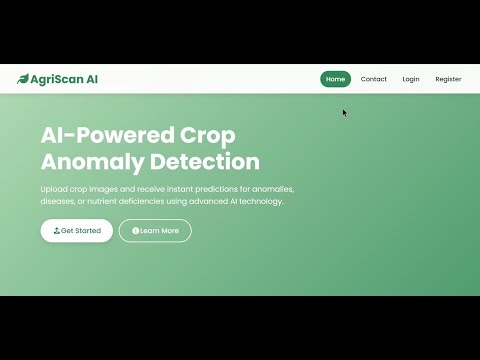
The proposed system combines the power of deep learning with an interactive user interface built using Flask for web deployment and Tkinter for desktop use. The Flask web application enables users to upload single or multiple images for real-time detection, while the Tkinter-based GUI offers a simple offline tool for quick batch predictions. Both interfaces enhance user accessibility and ensure that the system can be utilized by individuals with minimal technical expertise. The entire framework aims to bridge the gap between complex AI algorithms and practical agricultural use cases. During the model development stage, a well-structured dataset containing images of various crop conditions is preprocessed and augmented to improve diversity and prevent overfitting. Data preprocessing includes resizing images, normalization, and conversion into tensors that can be processed efficiently by the CNN.
OBJECTIVES
The main objective of this project is to design and develop a software-based Crop Anomaly and Camouflage Detection System that automatically identifies the health status of crops using deep learning and image processing techniques. The system aims to analyze crop images and classify them into three categories—Anomaly, Camouflage, and Healthy—using a trained Convolutional Neural Network (CNN) model. By implementing this intelligent software framework, the project seeks to assist farmers, researchers, and agricultural experts in diagnosing crop conditions accurately without the need for manual inspection.
A key objective is to build a robust CNN architecture capable of learning essential visual patterns, textures, and color variations in crop images to achieve high classification accuracy. The project focuses on optimizing preprocessing methods such as resizing, normalization, and augmentation to enhance data quality and ensure model generalization across diverse conditions. Another important goal is to develop a user-friendly Flask web interface that allows users to upload single or multiple crop images (or ZIP files) and instantly view prediction results in an accessible format. Additionally, the system aims to provide an offline desktop application using Tkinter, enabling users to test folders of crop images without internet connectivity. This ensures the solution remains practical, lightweight, and easily deployable across various devices. Integrating a secure SQLite database for managing user authentication and login sessions forms another key objective, ensuring data security and access control within the web platform.
Further objectives include the evaluation of the trained model’s performance using key metrics such as accuracy, precision, recall, and F1-score, along with measuring inference latency to assess real-time responsiveness. The software aims to maintain efficiency, reliability, and scalability while requiring minimal computational resources. Finally, the broader goal of the project is to demonstrate how artificial intelligence and computer vision can be applied effectively within agriculture through a purely software-based approach. The developed system serves as a foundation for future research and development in automated crop health monitoring, promoting sustainable farming and reducing the dependency on manual visual inspection.
Block Diagram
System Requirements
1. Software Requirements
• Operating System: Windows 10/11, Linux, or macOS
• Programming Language: Python 3.8 or higher
• Web Framework: Flask (for web deployment)
• GUI Framework: Tkinter (for desktop application)
• Database: SQLite (for user registration and login)
• Development Environment: VS Code, PyCharm, or Jupyter Notebook
• Browser: Google Chrome / Mozilla Firefox (for web interface)
• Additional Tools: Git (for version control), pip (for package management)
2. Libraries / Packages
• Deep Learning: TensorFlow, Keras
• Numerical & Data Handling: NumPy, Pandas
• Image Processing: Pillow (PIL), OpenCV
• Machine Learning & Metrics: scikit-learn
• Data Augmentation: ImageDataGenerator (from Keras)
• Visualization: Matplotlib, Seaborn
• Security & Utilities: Werkzeug (password hashing), zipfile, os, io
• Others: tqdm (for progress bars), PIL.ImageFile (for handling truncated images)
3. Hardware Requirements
• Processor: Intel i5/i7 or equivalent AMD processor
• RAM: Minimum 8 GB (16 GB recommended for faster training)
• GPU: NVIDIA GPU with CUDA support (optional but recommended for CNN training)
• Storage: Minimum 100 GB free disk space for datasets and models
• Display: 1366x768 or higher resolution for GUI
• Internet: Required for downloading libraries, datasets, and deploying Flask web app