Waste management is an important environmental challenge as household, commercial, and industrial waste continues to increase. Proper waste segregation helps improve recycling, reduce landfill usage, and support sustainable resource management. However, manual waste sorting can be time-consuming and may lead to incorrect classification.
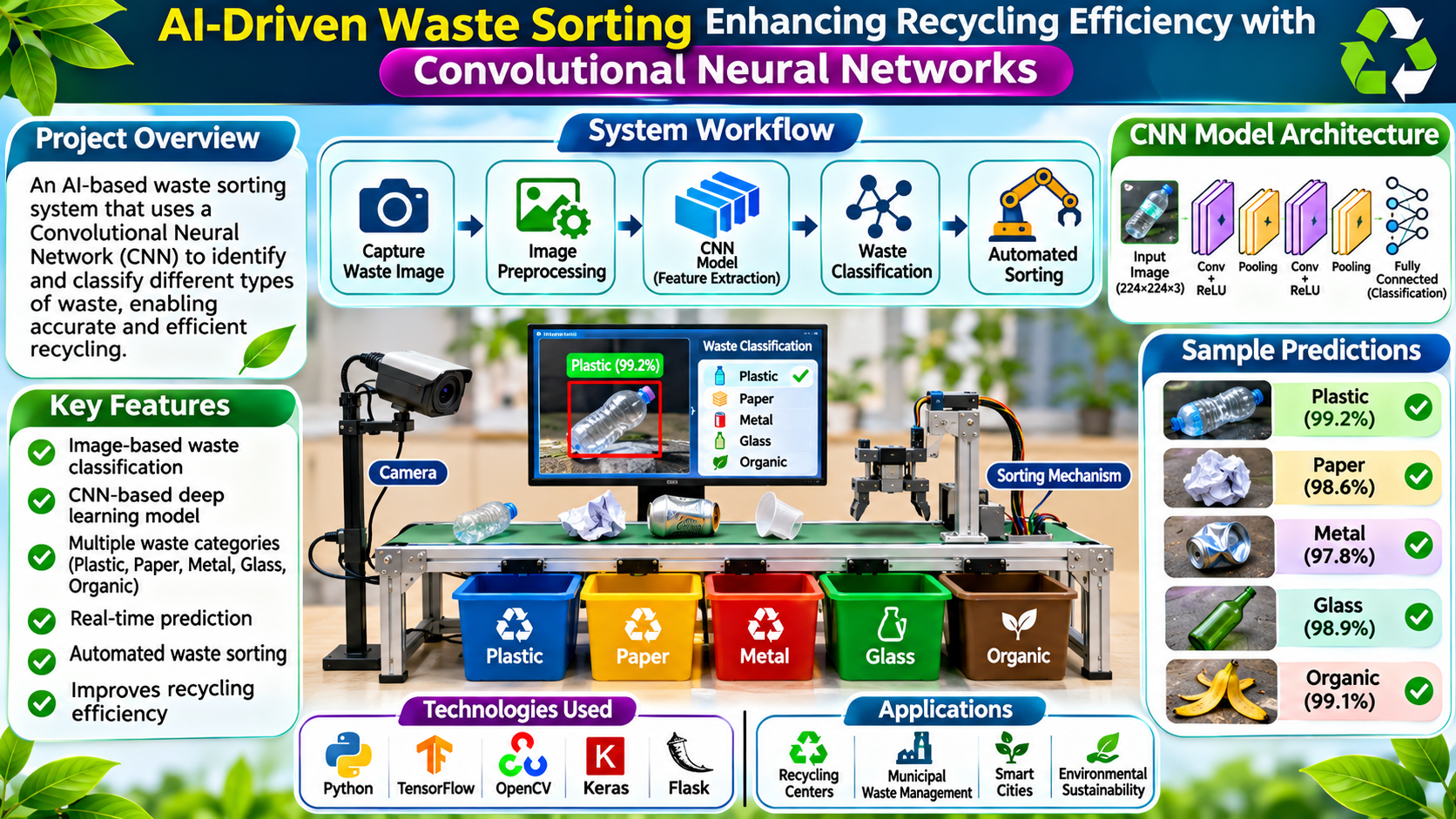
The AI-Driven Waste Sorting System Using Convolutional Neural Networks (CNN) project explores an automated approach to identifying different types of waste through image analysis. A camera captures waste images, and a trained deep learning model analyzes their visual features to predict the appropriate waste category.
By combining artificial intelligence, computer vision, and CNN-based image classification, this project demonstrates how smart technologies can support more efficient waste segregation and recycling processes.
Key Features & Benefits
Working Methodology
The system begins by collecting waste images using a camera or an existing image dataset. The images may represent categories such as plastic, paper, metal, glass, cardboard, and organic waste, depending on the selected dataset.
Before training, images are resized, normalized, and processed to maintain consistent input dimensions. Data augmentation techniques such as rotation, flipping, and zooming can be applied to improve model generalization.
A CNN model learns important image patterns, including edges, shapes, textures, and colour variations. During prediction, a new waste image is passed to the trained model, which generates a predicted category and confidence score.
Basic workflow:
Capture or upload a waste image.
Preprocess and resize the image.
Extract visual features using CNN layers.
Train the model using labelled waste images.
Evaluate the trained model.
Predict the waste category.
Display the classification result.
Implementation Guide
Features and Technologies
Key Features
Image-based waste classification.
CNN-based deep learning model.
Multiple waste category recognition.
Image preprocessing and augmentation.
Prediction confidence display.
Classification result visualization.
Potential integration with automated sorting equipment.
Technologies Used
Programming Language: Python.
Deep Learning: TensorFlow or Keras.
Model Architecture: Convolutional Neural Network (CNN).
Image Processing: OpenCV.
Data Processing: NumPy and Pandas.
Visualization: Matplotlib.
Interface: Flask or Streamlit.
Dataset: Custom waste image dataset or publicly available waste classification dataset.
Applications: Smart recycling centres, municipal waste management, automated segregation systems, industrial recycling, environmental monitoring, and educational AI projects.
Technical Specifications
Implementation and Future Scope
The implementation starts by collecting and organizing labelled waste images into separate categories. The dataset is divided into training, validation, and testing sets. Images are resized and normalized before being supplied to the CNN model.
The CNN architecture uses convolutional layers to extract visual features, pooling layers to reduce feature dimensions, and fully connected layers to perform classification. The model is trained using the prepared dataset and evaluated with accuracy, precision, recall, F1-score, and a confusion matrix.
After training, the model is integrated into a simple application where users can upload waste images and view the predicted category. For hardware-based extensions, the model can be connected to a camera and an automated sorting mechanism.
Advantages
Reduces dependence on manual image classification.
Supports consistent waste category recognition.
Demonstrates practical deep learning applications.
Can support automated recycling workflows.
Provides a foundation for smart waste management.
Future Enhancements
Integrate Raspberry Pi or NVIDIA Jetson hardware.
Connect servo motors for automatic waste separation.
Add real-time camera-based classification.
Support additional waste categories.
Explore lightweight CNN models for edge devices.
Develop a cloud-based waste monitoring dashboard.
Improve model performance with diverse real-world images.
Conclusion & Next Steps
Conclusion and References
The AI-Driven Waste Sorting System demonstrates how convolutional neural networks can be used to classify waste images and support intelligent recycling processes. By learning visual patterns from labelled images, the system can identify different waste categories and provide classification results.
This project is suitable for students interested in artificial intelligence, deep learning, computer vision, and environmental technology. Future integration with cameras, embedded systems, and automated sorting mechanisms can help develop more advanced waste management solutions.