Abstract :
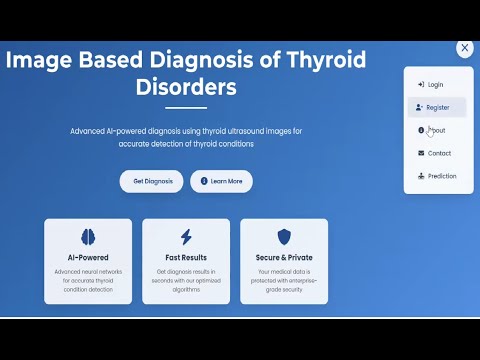
Thyroid disorders are among the most prevalent endocrine diseases, caused by imbalances in hormone secretion that influence metabolism, energy regulation, and body function. Early and accurate detection of these disorders is vital for effective treatment and prevention of complications. This project proposes an automated image-based thyroid disease prediction system utilizing Convolutional Neural Networks (CNN) for efficient and reliable classification. The model is trained to categorize thyroid gland images into three classes — Normal, Hypothyroid, and Hyperthyroid — based on extracted visual patterns and texture features. The dataset is preprocessed and augmented to improve model robustness and accuracy. The trained CNN model is integrated with a Flask-based web application, providing secure user registration, login authentication, and real-time image upload for disease prediction. Additionally, a Tkinter-based desktop interface enables offline testing and result visualization. The proposed system delivers accurate predictions with high confidence levels, demonstrating its potential as an assistive diagnostic tool in medical imaging and telemedicine applications.
Keywords:
Thyroid Disorder, Convolutional Neural Network (CNN), Deep Learning, Flask, Image Classification, Medical Imaging, Tkinter, Artificial Intelligence (AI), Disease Prediction.
Introduction:
1.1 Overview of Thyroid Disorders
The thyroid gland is a small, butterfly-shaped endocrine gland located at the base of the neck. It secretes two key hormones, Triiodothyronine (T3) and Thyroxine (T4), which play a vital role in regulating metabolism, body temperature, heart rate, and overall energy utilization. Any imbalance in the production of these hormones leads to thyroid disorders, the most common being Hypothyroidism (under-active thyroid) and Hyperthyroidism (over-active thyroid). These disorders can cause a wide range of health complications such as fatigue, weight fluctuations, depression, and cardiovascular problems. In severe cases, untreated thyroid dysfunction can lead to life-threatening conditions like myxedema coma or thyrotoxic crisis.
Thyroid diseases are increasingly common across the globe, especially among women and elderly populations. According to medical studies, nearly one in ten people may develop some form of thyroid disorder in their lifetime. The early and accurate diagnosis of thyroid abnormalities is therefore essential to ensure timely treatment and prevent complications. Traditional diagnostic methods include physical examination, blood tests for TSH, T3, and T4 levels, and ultrasound or radiographic imaging of the thyroid gland. While these techniques are effective, they are often dependent on the expertise of radiologists and endocrinologists. Manual interpretation of thyroid ultrasound images can sometimes lead to inconsistencies due to human subjectivity and limited visual assessment capabilities.
1.2 Need for Automation in Medical Imaging
With the rapid growth of healthcare data and digital imaging technologies, there is a growing need for automated diagnostic systems that can assist clinicians in decision-making. In the field of medical imaging, the integration of artificial intelligence (AI) and machine learning (ML) has brought about revolutionary changes. Deep learning, a subset of AI, has proven particularly effective in image recognition, segmentation, and classification tasks. Among deep learning architectures, the Convolutional Neural Network (CNN) has emerged as the most powerful and widely used model for visual data interpretation.
CNNs have the unique ability to automatically learn hierarchical features from raw images without requiring explicit manual feature extraction. This makes them particularly suitable for analyzing complex medical images, such as MRI scans, X-rays, and ultrasound images. In the context of thyroid imaging, CNNs can identify subtle patterns and textural differences that may not be easily detectable by the human eye. By automating the feature extraction and classification processes, CNN-based systems can enhance diagnostic accuracy, reduce human error, and enable faster medical assessments.
Block Diagram