ABSTRACT:
Low-light image enhancement is a significant challenge in the field of digital image processing, as images captured under poor illumination often suffer from reduced visibility, low contrast, and color distortion. This research project presents an intelligent image enhancement system based on deep learning techniques that automatically improves the quality of low-light images. The proposed model integrates a Convolutional Neural Network (CNN) architecture using LLNet and UNet frameworks to learn the mapping between low-light and well-illuminated image pairs. The system was trained on a large dataset of low- and high-quality image samples, enabling it to enhance brightness, recover fine details, and restore natural color balance.
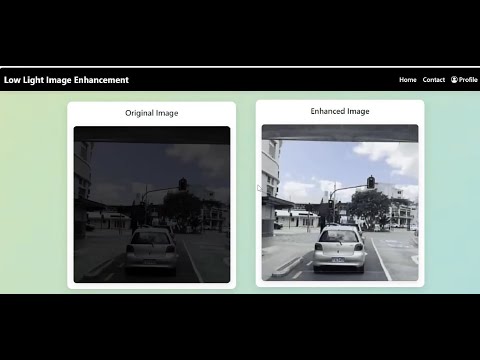
The project further incorporates a user-friendly web interface built using Flask, allowing users to upload low-light images and obtain enhanced outputs in real time. The enhancement process involves both deep learning–based reconstruction and post-processing operations such as gamma correction, contrast adjustment, and edge preservation to achieve high visual fidelity. Performance metrics such as Peak Signal-to-Noise Ratio (PSNR) and Structural Similarity Index Measure (SSIM) were employed to evaluate the model’s efficiency and perceptual quality. Experimental results demonstrate that the proposed system effectively enhances visibility and contrast while minimizing noise amplification and detail loss. The integration of machine learning and web-based deployment ensures accessibility, scalability, and usability for various real-world applications such as photography, surveillance, medical imaging, and autonomous vision systems. This project highlights the potential of deep learning to achieve superior low-light enhancement, offering a practical and automated solution to one of the core challenges in modern computer vision.
INTRODUCTION:
In the modern digital era, image processing plays a vital role in numerous domains such as photography, surveillance, medical imaging, autonomous driving, and computer vision-based systems. The quality of an image directly influences the efficiency of subsequent visual tasks such as object detection, classification, and segmentation. However, images captured under low-light conditions often suffer from severe degradation in brightness, visibility, and contrast, which significantly hampers their usability. Low illumination results in images with excessive noise, color distortion, and a loss of important structural details. Enhancing such images manually requires advanced editing skills and is time-consuming, thereby necessitating the need for automated enhancement methods. Traditional image enhancement techniques, such as histogram equalization and gamma correction, improve brightness and contrast but often fail to preserve the natural color distribution and finer textures of the image. These methods are limited by their inability to adapt dynamically to varying illumination levels across different regions of an image. With the rapid advancements in artificial intelligence, deep learning–based approaches have emerged as powerful tools for solving such complex image enhancement challenges. By leveraging convolutional neural networks (CNNs), deep learning models can automatically learn nonlinear mappings between low-light and normal-light image pairs, leading to more realistic and visually pleasing enhancements. This project focuses on developing a deep learning–based low-light image enhancement system that combines the strengths of LLNet and UNet architectures. LLNet (Low-Light Net) is an unsupervised autoencoder-based model designed for illumination correction and noise suppression, while UNet is a fully convolutional network that uses skip connections to retain fine image details during reconstruction. The integration of these architectures allows the system to not only increase brightness but also to restore lost features and color balance effectively. The model was trained on paired datasets containing low-light and high-light images to learn complex enhancement patterns directly from data. The proposed system is implemented using PyTorch, a popular deep learning framework that provides efficient GPU-based computation. To ensure real-world applicability, the trained model is deployed through a Flask web application, which offers a simple and interactive user interface. Through this platform, users can upload their low-light images, and the system automatically processes them to generate enhanced versions in real time. The backend model performs enhancement through multiple stages including noise reduction, brightness normalization, contrast adjustment, and detail restoration. In addition to deep learning enhancement, several post-processing operations are integrated to improve the perceptual quality of the final image. These include gamma correction, Contrast Limited Adaptive Histogram Equalization (CLAHE), edge enhancement, and tone adjustment. Such hybrid processing ensures that the output images are visually natural and free from overexposure or excessive saturation. The system is capable of handling different image formats and resolutions, making it robust and versatile for practical use.
Block Diagram