ABSTRACT:
Groundwater is one of the most essential natural resources for agriculture, domestic consumption, and industrial activities. With increasing population growth, climate variability, and rapid urbanization, the availability of groundwater has been declining at an alarming rate in many regions. Traditional groundwater assessment methods rely on manual surveys and hydrological estimations, which are time-consuming, costly, and limited in accuracy. To address these challenges, this project presents an AI-Enabled Water Well Predictor, a machine learning–driven solution designed to forecast the Net Ground Water Availability for Future Use using historical and region-specific hydrological parameters. The system integrates multiple machine learning models—including Linear Regression, Random Forest Regression, and a Neural Network (Keras-based Deep Learning model)—to analyse factors such as rainfall recharge, groundwater extraction, monsoon and non-monsoon recharge variations, domestic and industrial water usage, and groundwater allocation trends. The Random Forest model demonstrated superior performance among all models, offering high robustness, reduced error, and better generalization, and was consequently deployed as the final prediction engine.
The dataset used in this project consists of state-wise and district-wise groundwater statistics from verified government sources, processed through advanced preprocessing techniques such as One-Hot Encoding, Standard Scaling, and pipeline-based transformations. The final trained model was integrated into a fully functional Flask-based web application, allowing users to input district-specific parameters and receive real-time groundwater availability predictions. The system also implements user authentication features like registration, login, password hashing, and session handling, ensuring secure access to the prediction interface. This AI-driven approach enables faster, more accurate, and scalable groundwater forecasting compared to traditional techniques. By providing real-time predictions and region-specific insights, the application supports better resource planning for agricultural departments, water management authorities, and policy makers. The proposed system demonstrates how artificial intelligence can be leveraged to promote sustainable water resource management, making it a useful tool for future environmental planning and decision-making.
INTRODUCTION :
Groundwater is one of the most vital natural resources that sustains human life, agricultural productivity, and industrial development. In many regions across the world, groundwater serves as the primary source of drinking water and irrigation, making it crucial for socio-economic stability. However, with the continuous rise in population, rapid urbanization, and increasing industrial demands, the pressure on groundwater resources has intensified significantly. The imbalance between groundwater extraction and natural recharge has resulted in declining water levels, deteriorating water quality, and increased occurrences of drought-like conditions. These challenges highlight the urgent need for effective monitoring, assessment, and prediction of groundwater availability. Traditionally, groundwater estimation has relied on hydrological surveys, manual calculations, and government assessments conducted at periodic intervals. While these methods provide useful insights, they often lack real-time accuracy and are limited by the scale and frequency of data collection. Moreover, manual assessments are time-consuming, expensive, and prone to human errors. As groundwater behaviour becomes increasingly complex due to climate change and irregular rainfall patterns, conventional techniques alone are insufficient for accurate resource planning.
In recent years, advancements in artificial intelligence and machine learning have provided powerful tools for analysing large datasets and making accurate predictions. Machine learning models are capable of identifying hidden patterns and relationships among multiple hydrological parameters, even when the data is noisy or incomplete. This has paved the way for developing intelligent systems that can assist in resource management and decision-making. Motivated by these technological opportunities, this project introduces an AI-Enabled Water Well Predictor designed to forecast the Net Ground Water Availability for Future Use. The system utilizes a comprehensive dataset containing district-wise and state-wise groundwater statistics, including monsoon recharge, non-monsoon recharge, groundwater extraction for irrigation, domestic and industrial usage, groundwater allocation, annual rainfall contributions, and other significant hydro-geological indicators. These parameters form the basis for training multiple machine learning algorithms, including Linear Regression, Random Forest Regression, and a Deep Learning Neural Network model. Each model is evaluated based on accuracy metrics such as R² score, MAE, and RMSE, enabling the selection of the most effective model for deployment. The Random Forest model demonstrated superior predictive performance and was therefore chosen as the main engine for real-time prediction.
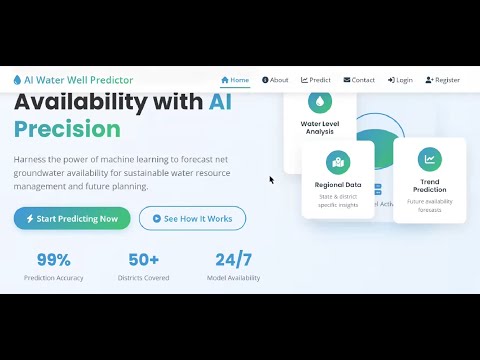
To ensure accessibility and practical usability, the trained model is integrated into an interactive Flask-based web application. The application features a user-friendly interface where users can enter state, district, and groundwater-related numeric values to obtain immediate predictions. It also includes a secure authentication system with user registration, login, hashed passwords, and session management to protect user data and restrict access to authorized users. By combining machine learning with a web-based interface, the system provides a reliable, scalable, and user-centered platform for groundwater forecasting. This project aims to bridge the gap between environmental data analysis and real-world water resource management. The integration of AI techniques helps reduce reliance on manual assessments, offering a faster, more consistent, and data-driven decision support system. The Water Well Predictor can aid government agencies, agricultural planners, researchers, and environmental policymakers in managing groundwater resources more efficiently. As water scarcity becomes a global concern, intelligent systems like this play a critical role in promoting sustainability and ensuring long-term resource availability. In addition to providing a data-driven approach for groundwater prediction, this project emphasizes the importance of integrating modern computational techniques into environmental resource management. As governments and institutions increasingly depend on digital technologies, machine learning offers a scalable and cost-effective pathway to analyse complex water-related datasets with higher precision. By leveraging such technological advancements, it becomes possible to forecast groundwater conditions at a finer spatial and temporal resolution, enabling rapid responses to emerging water scarcity challenges. Another major advantage of applying artificial intelligence in groundwater studies is its ability to process nonlinear relationships among variables. Hydrological factors like rainfall recharge, extraction rate, seasonal variations, and soil-water interactions often exhibit highly nonlinear behaviour. Conventional statistical models fail to capture these complex dependencies accurately. Machine learning algorithms, especially Random Forests and Neural Networks, excel in identifying such hidden patterns, making them ideal for environmental prediction tasks. This project demonstrates how the combination of diverse ML algorithms strengthens the overall prediction accuracy.
PROBLEM STATEMENT :
Groundwater plays a crucial role in sustaining agricultural productivity, industrial activities, and domestic water usage across many regions, especially in developing countries where surface water resources are limited. Despite its significance, groundwater reserves are rapidly declining due to excessive extraction, unplanned usage, climate variations, and inefficient management practices. Traditional methods of monitoring groundwater rely heavily on manual surveys, field inspections, and periodic hydrological reports that are often outdated by the time they are published. These manual approaches are not only time-consuming but also lack the accuracy and scalability required for modern water resource planning. Another major challenge is the absence of real-time prediction tools that can estimate future groundwater availability based on current extraction patterns and environmental conditions. Factors such as monsoon recharge, non-monsoon recharge, rainfall variability, industrial usage, agricultural pumping, and domestic consumption are highly dynamic and interdependent. Lack of predictive insights leads to over-extraction, declining water tables, increased drought vulnerability, and long-term environmental degradation. Many districts and states also lack digital tools that combine environmental data with predictive analytics in an accessible format. Existing groundwater assessments are typically published as static reports and cannot provide personalized predictions for specific locations or updated inputs. As a result, farmers, policymakers, and water management departments do not have access to timely, district-level forecasting systems that can guide effective decision-making. Without predictive tools, critical interventions—such as water conservation strategies, irrigation planning, and groundwater protection policies—are delayed or misinformed. In addition, there is a need to integrate artificial intelligence into groundwater forecasting to enhance accuracy and automate data-driven decision support. Machine learning models, when trained on historical and region-specific groundwater parameters, have the potential to deliver highly accurate predictions. However, there is limited implementation of such AI-enabled systems at the district level, and very few models are deployed through user-friendly platforms that allow direct public interaction. Therefore, the core problem addressed in this project is the lack of an automated, accurate, and accessible groundwater prediction system capable of processing multiple hydrological variables and delivering real-time estimates of Net Ground Water Availability for Future Use. There is a pressing need to develop a robust machine learning–based solution that can analyse diverse parameters, predict groundwater availability reliably, and present the results through a secure, interactive, and easy-to-use web application.
OBJECTIVES:
The primary objective of this project is to develop an intelligent, data-driven system capable of predicting the Net Ground Water Availability for Future Use using advanced machine learning and deep learning techniques. As groundwater levels continue to fluctuate due to climatic changes and excessive extraction, there is a strong need for accurate forecasting tools that can assist in sustainable resource planning. One of the key objectives is to analyse a diverse groundwater dataset containing district-wise and state-wise hydrological parameters such as monsoon recharge, non-monsoon recharge, annual extraction rates, industrial and domestic water usage, and groundwater allocation values. The goal is to identify meaningful patterns within these parameters and understand their influence on groundwater availability. Another important objective is to design, train, and evaluate multiple predictive models including Linear Regression, Random Forest Regression, and a Neural Network architecture. By comparing their performance using metrics such as R² score, MAE, and RMSE, the system aims to select the most accurate and reliable model for deployment. The project particularly focuses on ensuring that the selected model offers consistent accuracy across various regions and input conditions. A further objective is to create a robust preprocessing pipeline using techniques like One-Hot Encoding and Standard Scaling. This ensures that categorical and numerical features are processed correctly, enabling the machine learning models to achieve better accuracy and stability. The preprocessing pipeline also standardizes data transformation, making future model retraining easier and more consistent. Another major objective is to integrate the finalized machine learning model into a user-friendly Flask web application, allowing users to input district-specific values and receive instant predictions. The application is designed with an intuitive interface that can be easily used by individuals with little or no technical knowledge. Enhancing accessibility and ease of use is a significant goal of the project. Security is also an important objective. The system implements user authentication features such as registration, login, password hashing, and session management to ensure safe and controlled access to the prediction platform. Finally, the project aims to support sustainable groundwater management by providing accurate predictions that can assist policymakers, agricultural departments, environmental planners, and local authorities.
Block Diagram