ABSTRACT
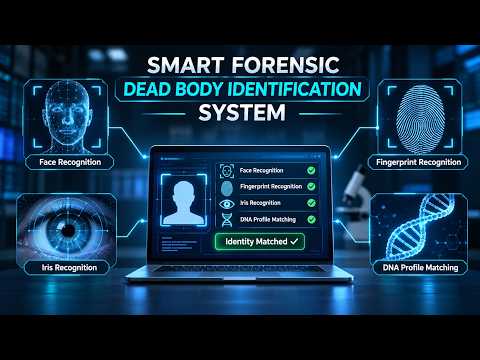
The Smart Forensic Dead Body Identification System is an intelligent biometric identification platform designed to assist forensic investigators in identifying unknown deceased individuals through multiple biometric characteristics. The identification of unidentified dead bodies is a significant challenge in forensic investigations, particularly in cases involving accidents, natural disasters, criminal incidents, and decomposed or unrecognizable bodies. Conventional identification procedures often require considerable time, manual examination, and specialized forensic expertise. To address these challenges, the proposed system integrates multiple biometric recognition techniques, including face recognition, fingerprint recognition, iris recognition, and DNA profile matching, into a unified web-based application. The system utilizes Python as its primary programming language, Flask as the web application framework, and computer vision techniques for biometric feature extraction and comparison. Face recognition is performed using facial encodings and distance-based similarity measurement to identify individuals from stored facial samples. Fingerprint and iris recognition employ OpenCV-based preprocessing techniques, Contrast Limited Adaptive Histogram Equalization (CLAHE), Gaussian filtering, and Oriented FAST and Rotated BRIEF (ORB) feature extraction to improve image quality and identify distinctive biometric patterns. DNA identification is implemented through genetic profile comparison by examining allele information across corresponding genetic loci and calculating the percentage of matching characteristics. The system maintains separate biometric databases containing the extracted facial encodings, iris descriptors, fingerprint descriptors, and DNA profiles for identification purposes. Additionally, a secure user authentication module is incorporated to provide registration and login facilities using password hashing and session-based access control. The proposed application supports individual biometric identification as well as combined case identification, allowing investigators to upload available biometric samples and retrieve corresponding identification results. A case mapping mechanism connects independently stored biometric records through predefined subject identifiers, enabling the retrieval of associated forensic information across different biometric modalities. Furthermore, the automatic identification module facilitates the identification process using an uploaded biometric sample and displays the corresponding linked records. By integrating multiple biometric identification approaches into a centralized forensic platform, the proposed system aims to improve the efficiency, accessibility, and organization of forensic identification procedures. This system can serve as a supportive technological solution for forensic departments, law enforcement agencies, and investigation authorities involved in unidentified dead body identification. The implementation is intended as a research and demonstration prototype, and its identification results require independent forensic verification before being considered as evidence in actual investigations.
INTRODUCTION
The identification of unidentified dead bodies is one of the most important and challenging responsibilities in forensic science and criminal investigation. Every year, numerous individuals lose their lives due to road accidents, natural disasters, industrial incidents, criminal activities, and other unexpected circumstances. In many situations, the deceased individuals cannot be identified immediately because their physical appearance may be severely affected by injuries, decomposition, burns, or other environmental conditions. Identifying such individuals is essential for establishing their identity, informing family members, completing legal procedures, and supporting criminal investigations. Traditional identification methods generally involve manual examination, physical characteristics, personal belongings, medical records, and forensic laboratory investigations. However, these procedures may require considerable time and specialized knowledge, particularly when the available physical evidence is limited or damaged. Therefore, the integration of intelligent technologies into forensic identification procedures has become increasingly important. The Smart Forensic Dead Body Identification System is proposed as a technology-oriented solution that combines multiple biometric identification techniques within a centralized application to support the identification of unknown deceased individuals.
Biometric identification refers to the process of recognizing an individual through unique biological or behavioural characteristics. Human facial features, fingerprints, iris patterns, and DNA profiles contain distinctive information that can be utilized for identity verification and recognition. Unlike conventional identification approaches that primarily depend on manually recorded personal information, biometric techniques provide measurable characteristics that can be compared against previously stored reference samples. Each biometric modality has its own identification mechanism, processing requirements, and limitations. Face recognition analyzes the structural characteristics of the human face, fingerprint recognition examines the distinctive ridge and valley patterns present on the fingertips, iris recognition evaluates the complex textural patterns surrounding the pupil, and DNA profiling compares genetic characteristics obtained from biological samples. By combining these modalities, a forensic identification platform can provide investigators with multiple possible sources of identification information rather than depending entirely on a single biometric characteristic. The proposed system integrates these four biometric modalities to establish a comprehensive identification framework suitable for research and forensic demonstration purposes.
Face recognition is one of the major components of the proposed system because facial characteristics are commonly used in human identification procedures. The technique involves extracting distinctive numerical representations from facial images and comparing them with previously enrolled facial samples. In the proposed implementation, the Python face_recognition library is used to identify facial regions and generate facial encodings. These encodings represent the distinguishing characteristics of an individual's face in a numerical format. During database construction, multiple facial images belonging to different subjects are processed, and their corresponding encodings are stored together with subject identifiers in a serialized database file. When an investigator uploads a facial image for identification, the application extracts its facial encoding and calculates the distance between the uploaded encoding and the stored reference encodings. The closest matching representation is selected based on a predefined threshold. If the calculated distance satisfies the specified matching condition, the corresponding subject is returned as the identification result. This process reduces dependence on direct manual facial comparison and provides a computational approach for matching facial samples. However, the reliability of facial recognition may be influenced by image quality, lighting conditions, facial orientation, injuries, and post-mortem changes.
Fingerprint recognition is another essential component of the proposed forensic identification platform. Fingerprints consist of characteristic ridge patterns and local structural details that provide valuable information for individual identification. Even when facial identification becomes difficult, suitable fingerprint evidence may provide an alternative source for matching an unidentified individual with an available reference record. The proposed implementation uses OpenCV image-processing techniques to improve fingerprint image quality before extracting distinctive features. Initially, the uploaded fingerprint image is converted into grayscale representation, allowing the system to process intensity variations in the ridge structures. Contrast Limited Adaptive Histogram Equalization (CLAHE) is applied to improve local contrast and enhance the visibility of important fingerprint details. Subsequently, Gaussian filtering is performed to reduce unwanted noise and improve the consistency of the image. The Oriented FAST and Rotated BRIEF (ORB) algorithm is then employed to detect keypoints and generate binary feature descriptors. These descriptors represent distinctive local patterns that can be compared with the descriptors stored in the fingerprint database. A Brute-Force Matcher using the Hamming distance is utilized to compare the extracted descriptors, and suitable matches are identified based on a predefined distance condition. The subject associated with the highest number of acceptable matches is selected when the minimum matching requirement is satisfied. This approach provides a feature-based fingerprint comparison mechanism within the proposed application.
Iris recognition provides an additional biometric identification method based on the distinctive patterns present in the human iris. The iris is the circular, coloured structure surrounding the pupil, and its internal texture contains complex characteristics that can be used for biometric recognition. Iris patterns are generally considered useful for identification because they contain numerous local variations and structural features. In the proposed system, iris images are processed using OpenCV to prepare them for feature extraction and matching. The input image is first resized to a standardized dimension of 300 × 300 pixels to maintain consistency during processing. CLAHE is subsequently applied to improve local contrast and enhance the visibility of iris texture patterns. Following preprocessing, the ORB feature extraction algorithm detects distinctive keypoints and generates corresponding descriptors. These descriptors are stored in the iris database along with their respective subject identifiers and image filenames. During identification, the uploaded iris image undergoes the same preprocessing and feature extraction operations. The extracted descriptors are compared with the reference descriptors using a Brute-Force Matcher configured with the Hamming distance. The number of acceptable feature correspondences is calculated, and the subject with the highest matching score is considered the potential identification result when the minimum matching threshold is reached. This component expands the identification capability of the application by introducing an additional biometric modality that can complement facial and fingerprint recognition.
DNA profile matching is incorporated into the proposed system to provide a genetic-based identification mechanism. Deoxyribonucleic Acid (DNA) contains inherited genetic information that is distributed across different regions of the human genome. Specific genetic locations, commonly referred to as loci, contain allele variations that can be examined during forensic DNA profiling. These genetic characteristics can be compared between an unknown biological sample and previously recorded reference profiles. Unlike image-based biometric recognition, DNA identification involves the comparison of structured genetic information rather than visual features. In the proposed implementation, DNA reference profiles are maintained in a JSON-based database, where each subject is associated with corresponding genetic loci and allele information. When an unknown DNA profile is uploaded, the application reads the genetic information and compares the available allele values with those stored in the reference database. The comparison is performed by examining corresponding loci and determining whether the allele information matches. The system calculates a matching percentage based on the number of matching loci relative to the total number of comparable loci. The subject with the highest matching percentage is considered a potential match when the predefined minimum matching threshold is satisfied. This mechanism provides a computational demonstration of genetic profile comparison. However, the implemented percentage is a simplified software matching score and must not be interpreted as a validated forensic DNA match probability or a substitute for accredited laboratory analysis.
An important feature of the proposed system is the integration of different biometric modalities into a unified forensic identification framework. Individual biometric recognition techniques may produce different results depending on the availability and quality of the collected samples. For example, facial images may be unsuitable for comparison when the deceased individual has experienced significant facial damage, while fingerprint or iris samples may remain available for examination. Similarly, genetic profiling may provide an additional identification pathway when appropriate biological reference samples can be obtained. The proposed application provides separate identification modules for face, fingerprint, iris, and DNA samples, allowing each modality to be processed independently. In addition to individual identification, the system includes a combined case identification mechanism that accepts multiple biometric samples and compares their resulting subject identifiers. A case mapping module is used to associate records from different biometric datasets through predefined identifiers. This allows the application to retrieve corresponding records from other modalities when a potential match is obtained. The implementation also includes an automatic identification function that determines the uploaded biometric modality, performs the corresponding recognition procedure, and retrieves the associated records linked to the identified case. Since the biometric datasets may originate from independent sources, the case mapping represents an artificial association for demonstration and does not establish that all linked samples belong to the same real individual.
The development of the Smart Forensic Dead Body Identification System involves several software technologies, including Python, Flask, OpenCV, the face_recognition library, JSON, and Python serialization techniques. Python is selected as the primary programming language because it provides extensive support for image processing, biometric analysis, data manipulation, and web application development. OpenCV is utilized for image preprocessing, feature extraction, and descriptor matching in the fingerprint and iris identification modules. The face_recognition library supports facial encoding generation and similarity-based comparison. Flask serves as the web application framework and connects the backend identification functions with the user interface. The system provides separate web routes for registration, login, logout, and biometric identification operations. Users can upload the required biometric samples through the application, and the backend processes the submitted files before returning the identification results in JSON format. The use of a modular application structure makes it possible to maintain individual recognition procedures separately while integrating them through a common web interface. The extracted biometric information is stored in serialized database files, while DNA profiles and user account details are maintained using structured JSON storage in the current implementation.
Security and controlled application access are also considered during the development of the proposed platform. Since forensic identification involves sensitive personal and biological information, access to the identification modules should be restricted to authorized users. The system incorporates a user registration and authentication mechanism that allows new users to create accounts using a username, email address, and password. Passwords are stored as secure password hashes rather than being maintained directly as plain text. During login, the entered credentials are verified against the stored account information using password verification functions. Flask session management is used to maintain the authenticated user's access state. A login protection mechanism is applied to the main application pages and biometric identification routes so that unauthenticated users cannot directly access the protected functionality. This authentication structure provides a basic access-control mechanism for the prototype. In a practical forensic deployment, additional security measures such as encrypted biometric storage, role-based authorization, audit logging, secure transmission, controlled evidence handling, and compliance with applicable data protection regulations would be necessary.
The proposed system is intended to support the organization and preliminary examination of forensic identification information by providing a centralized platform for multiple biometric comparison techniques. It can be considered useful in research environments, forensic technology demonstrations, academic projects, and the development of automated identification workflows. The integration of facial, fingerprint, iris, and DNA recognition provides an opportunity to examine how different biometric technologies can complement one another within a single software application. The case mapping and linked-record retrieval functionalities further demonstrate how independently maintained biometric information can be connected through predefined identifiers for systematic record examination. Nevertheless, the accuracy of identification depends on the quality, authenticity, completeness, and suitability of the reference samples, as well as the reliability of the implemented recognition algorithms. The proposed application is therefore a research prototype rather than a certified forensic identification system. Its results should be independently examined by qualified forensic professionals and verified using legally accepted procedures before being used for official identification, investigative conclusions, or judicial evidence.
Overall, the Smart Forensic Dead Body Identification System represents an integrated approach to computer-assisted forensic identification through the application of computer vision, biometric feature extraction, genetic profile comparison, and web-based information management. By incorporating four different identification modalities into a single platform, the system aims to provide a structured and accessible mechanism for comparing unknown samples against stored reference records. Its modular architecture supports independent biometric processing, combined case examination, automatic modality selection, and retrieval of associated identification records. The application demonstrates the potential of artificial intelligence-related technologies, image-processing algorithms, and software-based data integration in improving the organization of forensic identification activities. The proposed work also establishes a foundation for future enhancements involving deep learning-based biometric recognition, advanced multimodal score fusion, secure forensic databases, automated evidence management, and validated identification procedures. Through these capabilities, the project seeks to contribute to the development of technology-assisted forensic investigation systems that can support the identification of unknown deceased individuals in a more systematic and efficient manner.
Block Diagram