ABSTRACT
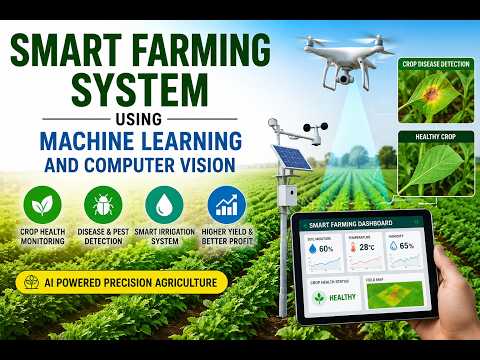
Agriculture remains the backbone of economies in developing nations, yet it is increasingly challenged by climate variability, soil degradation, inappropriate fertilizer usage, and the rapid spread of plant diseases. These challenges lead to poor crop yields, wasted resources, and financial hardship for farmers who lack access to timely, data-driven guidance. The Smart Farming System presented in this synopsis is a comprehensive, web-based precision agriculture platform that addresses three of the most critical decision points in the farming cycle using Machine Learning (ML) and Computer Vision (CV).
The system integrates three intelligent modules: a Crop Yield Prediction module that uses a Random Forest Classifier to recommend the most suitable crop based on environmental parameters; a Fertilizer Recommendation module that suggests the optimal fertilizer type from soil nutrient and weather data; and a Leaf Disease Detection module powered by a custom-trained YOLOv5 deep learning model that identifies plant diseases from uploaded leaf images in near real-time. The entire platform is deployed as a Flask web application featuring user authentication, dynamic data visualization using Matplotlib and Seaborn, prediction history logging, and an Apache Spark big data analytics dashboard. The crop prediction model achieves approximately 95.68% accuracy, the fertilizer model achieves 92.15%, and the YOLOv5 model delivers a mean Average Precision of approximately 87-92%. Future scope includes IoT sensor integration, mobile app deployment, and satellite imagery analysis for large-scale field monitoring.
INTRODUCTION
The global agricultural sector faces an unprecedented challenge: feeding a projected population of 9.7 billion by 2050 while managing declining soil fertility, erratic rainfall, and escalating crop disease outbreaks. In countries like India, where agriculture employs more than 50% of the workforce, the inability to make scientifically sound farming decisions leads to billions of dollars in annual losses. Traditional farming practices, relying on generational experience and rule-of-thumb knowledge, are increasingly inadequate in the face of modern environmental complexity.
Precision Agriculture, or Smart Farming, has emerged as the technological answer to these challenges. By combining sensor data, machine learning models, and computer vision, smart farming systems provide farmers with actionable, location-specific insights that replace guesswork with evidence-based recommendations. Machine learning algorithms such as Random Forests can process multiple soil and environmental variables simultaneously to predict optimal crop choices and fertilizer applications, while deep learning object detection models like YOLOv5 can scan leaf photographs for disease markers faster and more consistently than the human eye.
The Smart Farming System proposed here consolidates crop selection, fertilizer guidance, and disease detection into a single, user-friendly web interface built on the Flask framework. It also incorporates a big data analytics layer powered by Apache Spark, which aggregates historical prediction records for research and policy-level insights. This integrated approach distinguishes the proposed system from existing standalone tools and positions it as a practical, deployable solution for modern agricultural decision support.
OBJECTIVE
The primary objective of this project is to develop an integrated, intelligent web-based smart farming platform that provides real-time, data-driven recommendations to farmers and agricultural professionals. The specific objectives are:
• To build a Crop Yield Prediction module using a Random Forest Classifier that recommends the most suitable crop class based on seven environmental and soil parameters including temperature, humidity, rainfall, nitrogen, phosphorus, potassium, and pH.
• To develop a Fertilizer Recommendation module that maps eight soil-environment features to the optimal fertilizer type, reducing chemical overuse and promoting soil health.
• To implement a real-time Plant Leaf Disease Detection system using a custom-trained YOLOv5 deep learning model capable of identifying disease categories from uploaded leaf photographs with bounding box annotations.
• To deploy all three modules as an integrated Flask web application with user registration, login authentication, session management, prediction result visualization, and persistent history logging.
• To build an Apache Spark big data analytics dashboard that aggregates historical prediction data, computes statistical summaries, and presents insights for administrative and research purposes.
• To generate dynamic, context-rich data visualizations including performance metrics charts, feature importance plots, NPK distribution charts, and disease confidence bar graphs to aid user interpretation.
Block Diagram
SOFTWARE AND HARDWARE REQUIREMENTS
Software Requirements
Component Tool / Version Purpose
Operating System Windows 10/11 or Ubuntu 20.04+ Development & deployment environment
Language Python 3.8+ Core programming language
Web Framework Flask 2.x HTTP routing and template rendering
ML Library Scikit-learn 1.x Random Forest model training and evaluation
Deep Learning PyTorch + YOLOv5 (Ultralytics) Leaf disease object detection model
Data Analysis Pandas, NumPy Data manipulation and preprocessing
Visualization Matplotlib, Seaborn Dynamic chart generation
Image Processing OpenCV (cv2) Image resizing, conversion, annotation
Big Data Analytics Apache Spark / PySpark Distributed aggregation of history data
Database SQLite3 User authentication records
Model Persistence Joblib Saving and loading trained ML models
IDE VS Code / PyCharm Development environment
Hardware Requirements
Component Minimum Recommended
Processor Intel Core i5 (8th Gen+) Intel Core i7/i9 or AMD Ryzen 7
RAM 8 GB DDR4 16 GB or higher
Storage 256 GB SSD 512 GB SSD or more
GPU Not required (CPU inference) NVIDIA RTX 3060+ for CUDA acceleration
Network Standard broadband Broadband for model/library downloads
Display 1280x720 minimum 1920x1080 Full HD