ABSTRACT
Agricultural productivity is significantly affected by crop diseases and continuously changing environmental conditions, which often result in reduced yield and economic loss for farmers. Traditional crop disease identification methods rely on manual inspection and expert knowledge, making them time-consuming, subjective, and unsuitable for large-scale deployment. To address these limitations, this project presents an intelligent and automated crop disease detection and risk prediction system that integrates computer vision, deep learning, time-series analysis, and Internet of Things (IoT) sensor data. The proposed system employs a hybrid deep learning architecture that combines a custom Convolutional Neural Network (CNN) with a VGG16 pre-trained model to accurately identify crop diseases from leaf images by capturing both low-level texture features and high-level semantic representations. To enhance robustness and feature learning, an autoencoder is utilized for dimensionality reduction and noise suppression, enabling the system to handle variations in image quality and unseen patterns. In parallel, environmental parameters such as temperature, humidity, soil moisture, and light intensity are continuously collected from IoT sensors and analyzed using a Long Short-Term Memory (LSTM) network to model temporal dependencies and detect evolving risk trends over time. Additionally, an XGBoost classifier is employed to categorize environmental risk levels into low, medium, and high based on sensor data, ensuring accurate and reliable decision-making. The system integrates these models within a Flask-based web application that provides real-time disease prediction, risk assessment, and personalized recommendations, including prevention and treatment measures. To improve accessibility and usability for farmers, the application supports multilingual text translation and voice-based alerts. Experimental results demonstrate high disease classification accuracy, effective risk prediction, and real-time responsiveness, confirming the system’s suitability for precision agriculture applications. The proposed solution offers a scalable, cost-effective, and intelligent approach to crop health monitoring, enabling early disease detection, proactive risk management, and informed agricultural decision-making.
INTRODUCTION
Agriculture plays a vital role in the economic growth and food security of many countries, particularly in developing regions where a significant portion of the population depends on farming as a primary source of livelihood. Despite advancements in agricultural practices, crop productivity continues to be severely affected by plant diseases, unfavorable environmental conditions, and delayed decision-making. Crop diseases alone are responsible for substantial yield losses every year, impacting both small-scale farmers and large agricultural operations. Early detection of diseases and timely assessment of environmental risks are therefore critical to ensuring sustainable agricultural production and minimizing economic losses. Traditionally, crop disease identification is performed through manual inspection by farmers or agricultural experts. This approach requires extensive domain knowledge and experience, and its accuracy is often influenced by human subjectivity and environmental factors. Moreover, manual monitoring becomes impractical for large farmlands and does not support continuous surveillance. Similarly, environmental risk assessment is often based on isolated sensor readings or generalized weather forecasts, which fail to capture complex interactions among multiple parameters such as temperature, humidity, soil moisture, and light intensity. These limitations highlight the need for an intelligent, automated, and scalable system capable of monitoring crop health and environmental conditions in real time.
Recent advancements in artificial intelligence, particularly in deep learning and machine learning, have opened new possibilities for precision agriculture. Computer vision techniques enable automated analysis of crop images to detect visual symptoms of diseases, while machine learning models can analyze sensor data to identify patterns associated with crop stress and disease susceptibility. The integration of Internet of Things (IoT) devices with artificial intelligence further enhances the ability to collect continuous, real-time data from agricultural fields, enabling proactive decision-making rather than reactive responses. Among deep learning approaches, Convolutional Neural Networks (CNNs) have demonstrated remarkable performance in image classification and object recognition tasks. In agricultural applications, CNNs are widely used for plant disease detection due to their ability to automatically learn discriminative features from leaf images. However, standalone CNN models may struggle to generalize across varying lighting conditions, backgrounds, and disease stages. To overcome these challenges, transfer learning techniques using pre-trained models such as VGG16 are commonly employed. These models leverage knowledge learned from large-scale datasets and provide robust feature extraction capabilities, significantly improving classification accuracy and convergence speed.
While image-based disease detection is essential, crop health cannot be accurately assessed using visual information alone. Environmental conditions play a crucial role in disease development and progression. Factors such as prolonged humidity, high temperature, and improper soil moisture create favorable conditions for fungal and bacterial infections. Therefore, integrating sensor-based environmental data with image analysis is necessary for comprehensive crop monitoring. Time-series data collected from sensors exhibit temporal dependencies that cannot be effectively modeled using traditional machine learning techniques. Recurrent neural networks, particularly Long Short-Term Memory (LSTM) networks, are well-suited for modeling such sequential data, as they can capture both short-term fluctuations and long-term trends in environmental conditions.
In addition to deep learning models, ensemble learning techniques such as Extreme Gradient Boosting (XGBoost) have gained popularity due to their high accuracy, robustness, and efficiency. XGBoost is particularly effective in handling structured sensor data and nonlinear relationships among environmental parameters. By combining XGBoost with deep learning models, the system can leverage the strengths of both approaches—deep feature learning from images and powerful classification from structured data—resulting in more reliable risk prediction. Another important aspect of intelligent agricultural systems is robustness and adaptability to real-world conditions. Crop images captured in natural environments often contain noise, occlusion, and variations in resolution and lighting. Autoencoders address this challenge by learning compact and meaningful representations of input data, reducing noise and redundancy. In this project, autoencoders are employed to enhance feature learning and improve the system’s ability to handle unseen or anomalous patterns, thereby increasing reliability in real-world deployments.
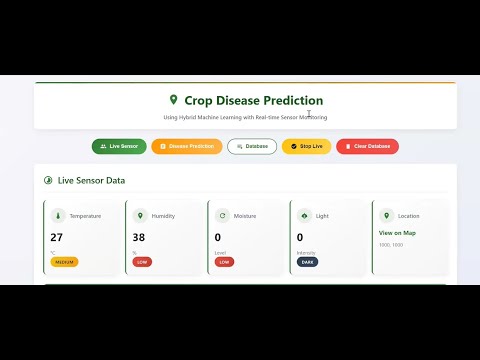
The practical implementation of such intelligent systems requires an effective deployment platform that can integrate multiple models, manage data storage, and provide user-friendly interaction. Web frameworks such as Flask enable seamless integration of machine learning models into real-time applications. Through a web-based interface, users can upload crop images, view live sensor data, receive disease predictions, assess environmental risk levels, and access actionable recommendations. Furthermore, database integration ensures persistent storage of sensor readings and prediction results, allowing historical analysis and performance evaluation. Accessibility is another critical factor in agricultural technology adoption. Farmers often face language barriers and limited technical expertise, which can hinder the effective use of advanced systems. To address this issue, multilingual text support and voice-based alerts are incorporated into the proposed system. By providing recommendations and warnings in regional languages through text-to-speech functionality, the system ensures wider usability and inclusivity, particularly in rural areas.
This project proposes an intelligent crop disease detection and risk prediction system that integrates hybrid deep learning models, time-series analysis, and IoT-based environmental monitoring within a unified framework. The system combines a custom CNN with a VGG16 pre-trained model for accurate disease classification, utilizes autoencoders for feature enhancement, applies LSTM networks for temporal analysis of sensor data, and employs XGBoost for environmental risk categorization. A Flask-based web application serves as the deployment platform, offering real-time predictions, multilingual support, and decision-oriented recommendations. By addressing both visual symptoms and environmental risk factors, the proposed system moves beyond conventional disease detection approaches and provides a comprehensive solution for precision agriculture. The integration of advanced artificial intelligence techniques with real-time sensor data enables early detection of diseases, proactive risk management, and informed decision-making. Ultimately, this system aims to improve crop yield, reduce losses, and support sustainable agricultural practices through intelligent automation and data-driven insights.
OBJECTIVES
The primary objective of this project is to design and implement an intelligent, automated, and scalable crop monitoring system that accurately detects crop diseases and predicts environmental risk levels by integrating deep learning, machine learning, time-series analysis, and Internet of Things (IoT) technologies. The system aims to minimize crop losses caused by delayed disease detection and ineffective environmental monitoring by providing timely, data-driven insights that support informed decision-making in agricultural practices. By combining image-based disease diagnosis with real-time sensor data analysis, the project seeks to bridge the gap between traditional farming methods and modern precision agriculture techniques. One of the core objectives of this project is to develop a robust image-based crop disease detection mechanism using a hybrid deep learning architecture. This involves leveraging a custom Convolutional Neural Network (CNN) to capture low-level visual features such as texture, edges, and color variations from crop leaf images, while simultaneously employing a pre-trained VGG16 model to extract high-level semantic features. The objective is to improve classification accuracy and generalization by fusing complementary feature representations, thereby overcoming the limitations of standalone CNN models when applied to real-world agricultural images captured under varying environmental conditions. Another important objective is to enhance the reliability and robustness of image feature extraction through the use of autoencoders. The project aims to utilize autoencoders to learn compact and meaningful representations of crop images, reduce noise, and suppress irrelevant background information. This objective is particularly significant in agricultural environments where images may suffer from inconsistent lighting, occlusions, motion blur, and variations in resolution. By improving feature quality, the system aims to achieve consistent disease classification performance even under suboptimal image acquisition conditions.
A key objective of the project is to incorporate temporal intelligence into environmental risk assessment by modeling sensor data as time-series sequences. The system aims to employ Long Short-Term Memory (LSTM) networks to analyze historical patterns in temperature, humidity, soil moisture, and light intensity. This objective focuses on capturing both short-term fluctuations and long-term trends in environmental conditions that contribute to disease development. By doing so, the system seeks to move beyond static threshold-based monitoring and enable predictive risk analysis that can forecast unfavorable conditions before visible symptoms appear on crops. In addition to deep learning models, the project aims to utilize ensemble machine learning techniques to strengthen environmental risk classification. Specifically, the objective is to implement an XGBoost classifier that analyzes structured sensor data and categorizes environmental risk levels into low, medium, and high classes. The use of XGBoost is intended to exploit its ability to model nonlinear relationships, handle feature interactions, and deliver high accuracy with computational efficiency. This objective ensures that the system provides reliable and interpretable risk predictions that complement the outputs of deep learning models. Another critical objective of the project is to design a hybrid decision-making framework that combines artificial intelligence–based predictions with logical, rule-based risk evaluation. This objective addresses the need for system reliability in real-world deployments by introducing deterministic reasoning alongside probabilistic model outputs. By integrating domain knowledge–driven rules with AI predictions, the system aims to reduce false alarms, improve trustworthiness, and enhance the practical usability of risk assessments for farmers and agricultural stakeholders. The project also aims to achieve real-time data acquisition and processing through seamless integration with IoT sensors. This objective involves continuously collecting live environmental data such as temperature, humidity, soil moisture, light intensity, and geographical location from remote sensors via an application programming interface (API). By enabling real-time monitoring, the system seeks to ensure that disease detection and risk prediction are based on the most recent field conditions, thereby supporting timely interventions and reducing response latency. A further objective is to develop a unified, end-to-end software platform that integrates multiple artificial intelligence models within a single deployment environment. The project aims to utilize a Flask-based web framework to host deep learning and machine learning models, manage data flow, and provide RESTful services for real-time interaction. This objective ensures modularity, scalability, and ease of integration, allowing the system to be extended to additional crops, diseases, or sensor types in the future. Data persistence and historical analysis form another important objective of the project. The system aims to design and implement a structured database using SQLite to store sensor readings, disease predictions, confidence scores, risk levels, and timestamps.
Block Diagram