ABSTRACT
The rapid growth of healthcare data presents an unprecedented opportunity to leverage machine learning for automated disease detection and prediction. This synopsis presents a comprehensive machine learning-based system designed to predict medical conditions in patients using structured clinical and demographic data. The proposed system employs a Random Forest Classifier — a powerful ensemble learning algorithm — trained on a real-world healthcare dataset containing attributes such as age, gender, blood type, medication, admission type, billing amount, insurance provider, and laboratory test results.
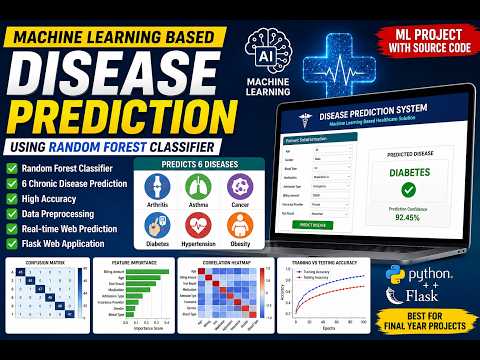
The pipeline includes thorough data preprocessing covering missing value imputation, label encoding, and feature selection. Model performance is evaluated using accuracy, precision, recall, and F1-score metrics. A Flask-based web application provides a real-time, user-friendly interface for disease prediction. The system classifies patients into six major chronic conditions: Arthritis, Asthma, Cancer, Diabetes, Hypertension, and Obesity.
Results demonstrate high classification accuracy with balanced per-class performance, confirming the feasibility of machine learning as a practical clinical decision support tool. Comprehensive visualizations — including confusion matrix, feature importance plots, correlation heatmap, and training-vs-testing accuracy charts — provide model interpretability for clinical stakeholders.
Keywords: Machine Learning, Random Forest Classifier, Healthcare, Disease Prediction, Flask, Data Preprocessing, Clinical Decision Support.
INTRODUCTION
Healthcare institutions worldwide generate massive volumes of patient data daily — from electronic health records to laboratory reports, imaging studies, and wearable sensor outputs. This data, if intelligently processed, holds the potential to revolutionize clinical diagnosis and patient care management. Machine learning, a subset of artificial intelligence, provides powerful computational frameworks capable of identifying patterns in historical data and making accurate predictions on new, unseen patient cases.
Disease prediction using machine learning bridges the gap between raw clinical data and actionable medical intelligence. Traditional diagnostic processes are often time-consuming, resource-intensive, and vulnerable to human error — particularly in settings with limited specialist availability. By training predictive models on large-scale patient datasets, healthcare providers can automate preliminary screening, facilitate early detection, and optimize the allocation of limited medical resources.
This project targets the prediction of six prevalent chronic diseases — Arthritis, Asthma, Cancer, Diabetes, Hypertension, and Obesity — which collectively account for the majority of non-communicable disease burden globally. The system processes patient demographic and clinical profiles, applies a trained Random Forest model, and delivers instant classification results through a web interface. The motivation is rooted in the World Health Organization's finding that chronic non-communicable diseases cause over 70% of global deaths annually, and that early detection can significantly reduce both morbidity and mortality.
The Random Forest algorithm is particularly suited for this domain due to its robustness to noisy data, ability to handle mixed feature types without scaling, resistance to overfitting through ensemble voting, and provision of interpretable feature importance scores that align with clinical reasoning.
OBJECTIVES
The primary objectives of this project are as follows:
• Design and implement an end-to-end machine learning pipeline for healthcare disease prediction using structured patient data.
• Perform comprehensive data preprocessing including missing value treatment, label encoding, and feature selection to enhance model performance.
• Train a Random Forest Classifier to accurately classify patients into six chronic disease categories.
• Evaluate model performance using accuracy, precision, recall, F1-score, and confusion matrix analysis.
• Identify the most significant clinical and demographic features contributing to prediction through feature importance analysis.
• Develop a Flask-based web application providing a real-time interface for disease prediction.
• Generate comprehensive visualizations for model interpretability and stakeholder communication.
• Serialize the trained model and encoders for efficient deployment without retraining.
• Demonstrate the practical viability of machine learning as a clinical decision support system.
Block Diagram
SOFTWARE AND HARDWARE REQUIREMENTS
Software Requirements
• Operating System: Windows 10/11, Ubuntu 20.04+, or macOS 12+
• Programming Language: Python 3.8 to 3.11
• Machine Learning: scikit-learn 1.2+
• Web Framework: Flask 2.x
• Data Processing: Pandas 1.5+ and NumPy 1.23+
• Visualization: Matplotlib 3.6+ and Seaborn 0.12+
• Model Serialization: Joblib 1.2+
• Development Environment: VS Code, PyCharm, or Jupyter Notebook (Latest)
• Package Manager: pip or Anaconda
Hardware Requirements
• Processor: Minimum Intel Core i3 / AMD Ryzen 3; Recommended Intel Core i5+ or AMD Ryzen 5+
• RAM: Minimum 4 GB; Recommended 8 GB or more for smooth training
• Storage: Minimum 5 GB free disk space; Recommended 10 GB SSD
• GPU: Not required for Random Forest; optional for future deep learning extensions
• Network: Required for initial package installation via pip
• Display: Minimum 1280 x 720; Recommended 1920 x 1080 for visualization clarity