ABSTRACT
Diabetes mellitus is one of the most prevalent chronic diseases worldwide and requires early detection and continuous monitoring to prevent severe health complications such as cardiovascular diseases, kidney failure, and vision loss. With the rapid advancement of artificial intelligence and medical imaging technologies, automated disease detection systems have become an effective solution for assisting healthcare professionals in diagnosis and decision-making. This project presents an intelligent diabetic disease detection system using deep learning techniques, specifically employing the MobileNetV2 convolutional neural network architecture for image-based classification. The proposed system classifies medical images into three categories: Normal, Moderate, and Severe, enabling early risk identification and timely medical intervention. Transfer learning is utilized by leveraging pre-trained ImageNet weights, which improves model accuracy while reducing training time and computational cost. Image preprocessing and data augmentation techniques such as normalization, rotation, zooming, and brightness adjustment are applied to enhance model generalization and robustness. The trained model is integrated into both a desktop-based Tkinter application and a web-based Flask application, allowing users to upload medical images and receive real-time predictions along with confidence scores. To enhance usability and accessibility, a secure user authentication system using SQLite is implemented, ensuring authorized access to prediction services. Additionally, the system includes an automated email notification feature that sends prediction results to registered users, improving awareness and follow-up actions. The web interface also provides condition-specific recommendations, where normal cases receive preventive awareness guidance, moderate cases are advised to consult medical professionals, and severe cases trigger emergency alerts emphasizing immediate treatment. Experimental results demonstrate that the proposed model achieves reliable accuracy and stable performance across all classes, making it suitable for real-world deployment. Overall, this project highlights the effectiveness of deep learning–based medical image analysis combined with user-friendly software design in supporting early diabetes detection, improving patient awareness, and assisting healthcare systems with scalable and cost-effective diagnostic solutions.
INTRODUCTION
Diabetes mellitus is a chronic metabolic disorder characterized by persistently elevated blood glucose levels due to insufficient insulin production, impaired insulin action, or a combination of both. Over the past few decades, diabetes has emerged as one of the most significant global health challenges, affecting millions of individuals across all age groups. The World Health Organization reports a steady increase in diabetes prevalence, particularly in developing countries where lifestyle changes, urbanization, and lack of awareness contribute to delayed diagnosis and poor disease management. If left undiagnosed or untreated, diabetes can lead to severe complications such as cardiovascular diseases, neuropathy, nephropathy, retinopathy, and limb amputations, significantly reducing quality of life and increasing mortality rates. Early detection and timely intervention are therefore critical in controlling disease progression and minimizing long-term health risks. However, conventional diagnostic methods rely heavily on clinical expertise, laboratory tests, and manual interpretation of medical data, which may be time-consuming, expensive, and inaccessible to many populations.
Recent advancements in artificial intelligence (AI) and machine learning (ML) have revolutionized the healthcare sector by enabling automated, accurate, and scalable diagnostic solutions. Deep learning, a subset of machine learning, has shown exceptional performance in medical image analysis by learning complex patterns directly from data without manual feature engineering. Convolutional Neural Networks (CNNs), in particular, have proven highly effective in tasks such as disease detection, medical image classification, and anomaly identification. These models can analyze high-dimensional image data and identify subtle variations that may not be easily detectable by human observers. As a result, deep learning-based diagnostic systems are increasingly being adopted to support healthcare professionals, reduce diagnostic errors, and improve decision-making efficiency. In the context of diabetes detection, image-based analysis combined with deep learning offers a promising approach to early risk assessment and disease classification.
Despite the potential benefits of deep learning in healthcare, building effective diagnostic systems presents several challenges. Medical datasets are often limited in size, imbalanced across disease classes, and sensitive in nature. Training deep neural networks from scratch on such datasets can lead to overfitting and poor generalization. To address these challenges, transfer learning has emerged as a practical and efficient solution. Transfer learning involves leveraging pre-trained models that have been trained on large-scale datasets, such as ImageNet, and fine-tuning them for specific medical applications. MobileNetV2 is one such lightweight and efficient CNN architecture designed for high performance with low computational requirements. Its depthwise separable convolutions and inverted residual structure make it particularly suitable for deployment in real-time applications and resource-constrained environments. By utilizing MobileNetV2 as the backbone model, this project achieves a balance between accuracy, speed, and computational efficiency.
The proposed diabetic disease detection system employs a deep learning-based approach to classify medical images into three clinically relevant categories: Normal, Moderate, and Severe. This classification framework is designed to support early diagnosis and guide appropriate medical responses. Normal cases indicate no immediate risk and emphasize preventive awareness, while moderate cases suggest the need for medical consultation and continuous monitoring. Severe cases represent critical conditions requiring urgent medical attention and immediate treatment. To enhance model robustness and reliability, data preprocessing and augmentation techniques such as image normalization, rotation, zooming, horizontal flipping, and brightness adjustment are applied during training. These techniques improve the model’s ability to generalize across varying image conditions and reduce sensitivity to noise and variations in input data.
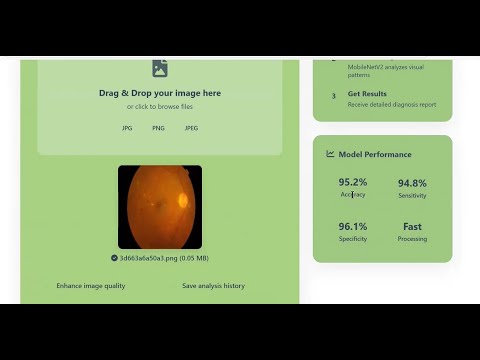
Beyond model development, the practical deployment of AI-based healthcare systems requires seamless integration with user-friendly interfaces and supporting software components. In this project, the trained deep learning model is integrated into both a desktop-based application and a web-based platform to ensure accessibility and usability for a wide range of users. The desktop application is developed using the Tkinter framework, allowing users to upload medical images and receive instant predictions along with confidence scores. This interface is particularly useful for offline analysis and standalone usage. In parallel, a Flask-based web application is implemented to provide remote access to the prediction system. The web platform includes secure user authentication using an SQLite database, ensuring that only authorized users can access diagnostic services and sensitive medical information.
OBJECTIVES
The primary objective of this project is to design and develop an intelligent diabetic disease detection system that utilizes deep learning techniques to accurately classify medical images into clinically meaningful categories. The system aims to identify diabetic conditions at an early stage by categorizing cases as Normal, Moderate, or Severe, thereby supporting timely medical intervention and improved disease management. By automating the classification process, the project seeks to reduce dependency on manual diagnosis, minimize human error, and enhance diagnostic consistency. The overarching goal is to provide a reliable and scalable solution that assists healthcare professionals and patients in understanding disease severity and taking appropriate preventive or corrective actions. Another key objective of the project is to leverage transfer learning through the use of the MobileNetV2 convolutional neural network architecture. Instead of training a deep learning model from scratch, the project aims to utilize pre-trained ImageNet weights to improve learning efficiency and performance, particularly when working with limited medical image datasets. By freezing the base layers of the pre-trained model and fine-tuning the classification layers, the system seeks to achieve high accuracy while maintaining low computational complexity. This approach enables faster training, improved generalization, and suitability for deployment on systems with limited hardware resources, making the solution practical for real-world healthcare applications.
An important objective is to enhance the robustness and reliability of the classification model through effective data preprocessing and augmentation techniques. The project aims to apply normalization, resizing, and image augmentation strategies such as rotation, zooming, horizontal flipping, and brightness adjustment to increase dataset diversity and reduce overfitting. These techniques are intended to improve the model’s ability to handle variations in image quality, lighting conditions, and orientations, ensuring consistent performance across different input samples. By strengthening model generalization, the system aims to provide accurate predictions even when exposed to unseen or real-world medical images.
Block Diagram