Abstract
The rapid growth of e-commerce platforms has resulted in an overwhelming number of product choices, often leaving customers confused when selecting the most suitable device. Traditional recommendation systems rely on collaborative or content-based filtering but lack conversational interactivity and real-time personalization. This project proposes an Electronics Recommendation Assistant built using Flask framework, Gemini AI, and a local product dataset to provide intelligent, interactive product guidance. The system enables users to converse naturally with the chatbot to specify their preferences based on product type (laptop/phone), user designation (student, gamer, developer, professional, designer), and budget constraints. The chatbot filters products from a structured dataset (student.json), dynamically displays product images, and suggests the best option under the given budget. Additionally, a secure MySQL-based authentication module is integrated for user login and registration. By combining conversational AI with structured recommendation rules, the system enhances user experience, reduces decision fatigue, and demonstrates the practical application of generative AI in e-commerce personalization.
Keywords
Artificial Intelligence, Product Recommendation System, Conversational AI, Google Gemini API, Flask Web Application, Streamlit, User Authentication, Recommender Systems, Chatbot, MySQL Database, Electronics Advisor, Human–Computer Interaction
Introduction
In the digital era, the availability of a vast array of electronic products such as laptops and smartphones has transformed the way users search, compare, and purchase devices. Online platforms like Amazon, Flipkart, and similar e-commerce portals present thousands of options across varying specifications, budgets, and use cases. While this abundance of choice empowers consumers, it also creates a paradox of choice, where users often struggle to make an informed and confident decision. Conventional search and filter mechanisms on e-commerce websites demand that users manually select specifications such as RAM, processor, screen size, or price range, which can be overwhelming for individuals who are not technically proficient. This creates a gap between product availability and user accessibility, leading to decision fatigue and potential dissatisfaction with purchases.
To bridge this gap, AI-driven recommender systems have emerged as powerful tools for personalized product suggestions. These systems analyze user behavior, preferences, and contextual information to generate recommendations that are more relevant than manual searches. However, many existing recommendation systems operate in the background and provide suggestions in a non-interactive format, often based solely on previous browsing or purchase history. This limits user engagement and fails to address situations where a user’s current need does not align with their historical data. To overcome this limitation, conversational recommender systems have been introduced, combining the power of dialogue-based interaction with product filtering logic. By simulating natural conversation, these systems allow users to express their requirements in everyday language, thereby simplifying the decision-making process.
Recent advances in Generative Artificial Intelligence (GenAI) have further strengthened the capabilities of conversational systems. Models such as Google’s Gemini demonstrate state-of-the-art performance in natural language understanding and generation, enabling chatbots to engage in human-like conversations. Unlike rule-based chatbots, generative models can understand contextual nuances, handle open-ended queries, and provide adaptive responses. This flexibility makes them highly suitable for product recommendation scenarios, where user requirements are diverse and dynamic. Integrating generative AI into a recommendation system allows not only structured product guidance but also the ability to engage in casual conversation, enhancing user trust and satisfaction.
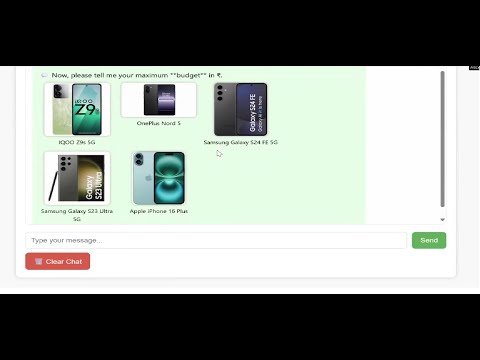
The proposed project, titled Electronics Recommendation Assistant using Gemini AI and Flask, aims to implement such a conversational recommendation platform for laptops and smartphones. The system uses a Flask-based web application as the primary user interface, ensuring a lightweight and scalable deployment. It is designed to guide the user step by step through the product selection process. Initially, the chatbot identifies whether the user is interested in a laptop or phone. It then queries the designation or user role (student, gamer, developer, office professional, or designer), which reflects the primary use-case scenario. Based on this input, the system filters products from a local structured dataset (student.json). Before requesting a budget, the chatbot displays multiple product options to the user, providing visual images along with product specifications. Finally, once the user provides their budget, the system recommends the best matching product under the given price constraint. This staged dialogue ensures that the user is neither overwhelmed with choices nor left without sufficient context.
The project also incorporates user authentication via MySQL, ensuring that only registered users can access the recommendation assistant. This feature is particularly valuable when extending the system for commercial use, where user accounts and personalization are critical. User passwords are securely stored using hashing mechanisms, safeguarding sensitive information. Moreover, the system maintains chat history within the session state, ensuring continuity in conversation and preserving context even across multiple interactions. This feature distinguishes it from many basic chatbot implementations that reset after every query.
A key feature of this assistant is its hybrid conversational capability. While structured queries such as product type, designation, and budget are managed through predefined logic, non-product queries are redirected to Google’s Gemini API. This ensures that if a user engages in small talk or asks unrelated questions, the chatbot still responds intelligently. For instance, if a user says “How are you?” or “Tell me a joke,” the system can reply naturally using Gemini, instead of returning an error or irrelevant message. This dual-mode interaction creates a more natural human–computer interaction, making the system engaging and user-friendly.
The decision to use Flask as the primary framework is motivated by its simplicity, flexibility, and compatibility with modern front-end technologies. Flask allows integration with Jinja2 templates, which are used to dynamically render the chat interface, product images, and responses. An additional implementation in Streamlit is also included to demonstrate rapid prototyping capabilities, particularly for data-driven visualization and interaction. Streamlit enables straightforward deployment of conversational flows and allows side-by-side image display for filtered products. Together, Flask and Streamlit offer complementary benefits—Flask serves as the main deployable application, while Streamlit supports interactive testing and validation of recommendation logic.
The dataset (student.json) is designed to store structured product details, including product type, designation, price, image path, and purchase link. By storing image paths locally and serving them through Flask routes, the system ensures that recommendations are both visual and descriptive, allowing users to make decisions with more confidence. This dataset-driven approach also makes the system highly extensible; new products can be added or updated without significant code modifications. For example, integrating additional categories such as tablets or accessories would only require dataset expansion and minor changes in the filtering logic.
From a practical perspective, the project demonstrates how conversational AI can significantly reduce the cognitive load on users when selecting electronic devices. Instead of sifting through hundreds of product listings, users engage in a guided dialogue where only the most relevant information is presented. Furthermore, by incorporating budget constraints, the assistant ensures that recommendations are realistic and financially suitable. The visual integration of product images, alongside text descriptions and purchase links, bridges the gap between technical specifications and user comprehension, thereby enhancing decision-making efficiency.
In summary, the Electronics Recommendation Assistant is a fusion of structured decision-making logic and generative conversational AI. It not only fulfills the functional requirement of recommending laptops and phones based on user needs but also enhances the user experience through natural dialogue, secure authentication, and personalized recommendations. As digital commerce continues to evolve, such AI-powered systems represent a promising direction for improving accessibility, personalization, and satisfaction in product discovery. The project demonstrates how combining Flask, Gemini, Streamlit, JSON datasets, and MySQL can create a scalable, intelligent, and user-friendly recommendation platform suitable for academic demonstration and practical deployment.
Block Diagram
Requirement Specification
Software requirement
The development of the Electronics Recommendation Assistant requires a robust software environment to ensure seamless integration of conversational AI with a product recommendation system. The application is implemented using Python 3.11, which provides the core programming environment and supports the integration of advanced libraries. The Flask web framework serves as the backbone for building the web application, enabling lightweight, scalable, and flexible interaction between the client and server. For artificial intelligence and natural language processing, the system integrates the Google Gemini API through the google-generativeai Python library, which allows the chatbot to understand user queries and respond in a natural conversational manner. The backend database is implemented using MySQL, which provides efficient data storage, retrieval, and management of structured product information. Additionally, a JSON dataset is utilized to store laptop and smartphone specifications, allowing easy filtering and retrieval based on product type, designation, and budget. Various supporting Python libraries such as Werkzeug (for security and authentication), difflib (for similarity matching in queries), and os/json modules (for data handling) are employed to enhance system efficiency. The web interface is designed using HTML, CSS, and JavaScript, integrated within Flask templates to provide an interactive user experience. To support deployment and testing, the project requires a stable Windows or Linux operating system with compatible package managers like pip for library installations. Overall, the combination of Flask, Gemini API, MySQL, and Python libraries provides a comprehensive software stack for building a reliable, scalable, and user-friendly recommendation assistant.