Abstract
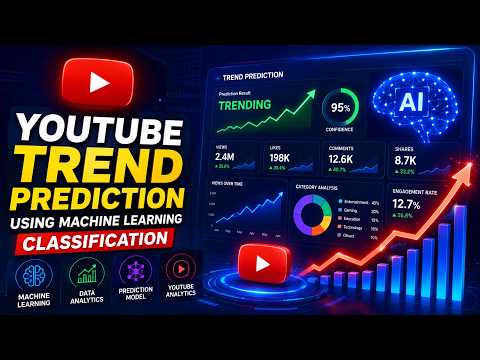
The YouTube Trend Prediction System is an intelligent, machine learning-based web application designed to predict whether a YouTube video is likely to trend based on its key performance indicators and metadata attributes. As video content competition on digital platforms intensifies, this project provides a data-driven classification system capable of identifying trending patterns from structured video data.
Three supervised learning algorithms are leveraged: Logistic Regression, Random Forest Classifier, and Support Vector Machine (SVM). Each model is trained on a curated dataset of ten features — view count, likes, dislikes, comment count, engagement rate, like ratio, comment ratio, title character length, publish hour, and category identifier — which together capture audience interaction dynamics, content quality signals, and upload timing factors correlated with trending behavior.
A Flask-based web application provides users with an intuitive interface to input video metrics and receive real-time predictions along with confidence scores from each model. The system dynamically selects the most confident model output as the final result and generates personalized, rule-based improvement suggestions covering optimal publishing hours, engagement strategies, and title optimization. Experimental results demonstrate that the Random Forest ensemble achieves superior classification accuracy, benefiting from its capacity to capture non-linear feature relationships.
Introduction
YouTube, with over 500 hours of video uploaded every minute, has become the world's dominant video-sharing platform. For content creators, media agencies, and digital marketers, understanding the mechanisms that drive a video to the trending section represents a critical competitive advantage. Trending on YouTube translates directly into exponential viewership growth, subscriber acquisition, advertising revenue, and brand recognition.
Traditional content strategy relies heavily on creator intuition and manual trend monitoring — approaches that are inherently limited in scalability and objectivity. Machine learning offers a powerful alternative: by training classification models on historical data of both trending and non-trending videos, predictive systems can generalize learned patterns to new content, process multiple feature dimensions simultaneously, and deliver predictions with quantified confidence levels.
This project introduces a YouTube Trend Prediction System combining the predictive power of three machine learning algorithms with an accessible Flask web interface. The three core algorithms represent fundamentally different approaches to the binary classification problem:
• Logistic Regression — provides a probabilistic linear baseline, interpretable and computationally efficient.
• Random Forest Classifier — employs ensemble learning on bootstrapped decision trees, robust against overfitting.
• Support Vector Machine (SVM) — identifies the optimal hyperplane maximally separating trending from non-trending classes.
The system follows a clean three-tier architecture: a data preprocessing and model training pipeline, a joblib-based model persistence layer, and a Flask web application serving the user interface. User authentication is implemented with SQLite and Werkzeug secure password hashing.
Objectives
• Develop an intelligent YouTube trend prediction system using Logistic Regression, Random Forest, and SVM classification algorithms.
• Analyze YouTube video metadata — views, likes, dislikes, comments, engagement rate, title length, publish hour, and category — to identify trending patterns.
• Implement a Flask-based web application with secure user authentication, prediction modules, and real-time result display.
• Compare the performance of multiple machine learning models using confidence scores and automatically select the best-performing model for the final prediction.
• Provide dynamic, personalized suggestions and analytical insights that help content creators improve the trending potential of their videos.
Block Diagram
System Requirements
6.1 Hardware Requirements
Processor Intel Core i3 (8th Gen+) or AMD Ryzen 3 — min. 2.0 GHz; multi-core recommended
RAM Minimum 4 GB (8 GB recommended for full application stack)
Storage Minimum 2 GB available disk space (SSD recommended for faster model loading)
Display Minimum 1280×720 resolution
Network Internet connection required for initial package installation only
6.2 Software Requirements
Operating System Windows 10/11,
Python Version 3.8+ (3.10 or 3.11 recommended)
Flask Version 2.3+ — web framework for routing, templates, and session management
scikit-learn Version 1.2+ — ML algorithms, preprocessing, and evaluation metrics
Pandas / NumPy 1.5+ / 1.23+ — data manipulation and numerical computations
Matplotlib / Seaborn 3.6+ / 0.12+ — confusion matrix and performance visualizations
joblib 1.2+ — model serialization and deserialization
Werkzeug 2.3+ — secure password hashing for user authentication
SQLite3 Standard library — embedded database for user credential storage