Abstract
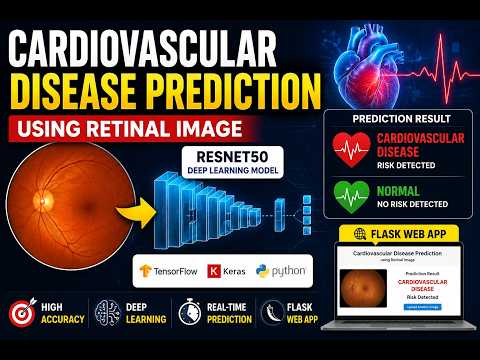
Cardiovascular diseases are one of the leading causes of death worldwide, making early diagnosis and continuous monitoring extremely important in modern healthcare systems. Traditional methods of detecting cardiovascular conditions often require expert medical analysis, expensive diagnostic equipment, and significant time for evaluation. With the rapid advancement of Artificial Intelligence, Deep Learning, and Computer Vision technologies, automated medical image analysis systems have become highly effective in assisting healthcare professionals with faster and more accurate disease detection. This project presents a Deep Learning-based Cardiovascular Disease Detection System using ResNet50 architecture and a Flask-based web application for real-time prediction and analysis. The primary objective of this project is to develop an intelligent and automated system capable of detecting cardiovascular conditions from medical image datasets with high accuracy. The proposed system utilizes transfer learning with the pre-trained ResNet50 convolutional neural network model to classify medical images into two categories: cardiovascular disease and normal condition. The model is trained using TensorFlow and Keras frameworks with optimized fine-tuning techniques to improve prediction performance while reducing overfitting. Image preprocessing techniques such as resizing, normalization, and batch processing are applied to prepare the dataset for efficient model training. In this system, the ResNet50 model is used as the base architecture because of its powerful feature extraction capabilities and deep residual learning mechanism. The pre-trained weights help the model learn complex image patterns efficiently even with limited medical image datasets. Additional custom layers including Global Average Pooling, Batch Normalization, Dense layers, and Dropout layers are integrated into the architecture to enhance classification accuracy and improve model generalization. The final output layer uses sigmoid activation for binary classification. The model is compiled using the Adam optimizer with a very low learning rate to achieve stable convergence during training.
Introduction
Cardiovascular diseases (CVDs) are among the most dangerous and life-threatening health conditions affecting millions of people across the world. According to global health studies, heart-related diseases remain one of the leading causes of mortality, responsible for a significant number of deaths every year. These diseases include conditions such as coronary artery disease, heart failure, arrhythmia, and other disorders related to the heart and blood vessels. Early diagnosis and proper treatment are essential to reduce the risk of severe complications and improve patient survival rates. However, traditional diagnostic procedures often require specialized medical equipment, experienced healthcare professionals, and time-consuming clinical analysis. In many developing regions, access to advanced medical facilities is limited, making early detection difficult for many patients. Therefore, there is a growing need for intelligent automated systems that can support medical professionals by providing fast, accurate, and reliable disease prediction solutions.
Recent advancements in Artificial Intelligence (AI), Machine Learning (ML), and Deep Learning (DL) have transformed the healthcare industry by introducing intelligent diagnostic systems capable of analyzing medical data with high precision. Deep learning models, especially Convolutional Neural Networks (CNNs), have shown exceptional performance in image classification, object detection, and medical image analysis. These technologies are increasingly being used in healthcare applications such as cancer detection, brain tumor segmentation, diabetic retinopathy analysis, pneumonia detection, and cardiovascular disease prediction. The ability of deep learning algorithms to automatically extract complex features from images makes them highly suitable for medical diagnosis systems. By leveraging these technologies, healthcare systems can improve diagnostic accuracy, reduce human error, and assist doctors in making better clinical decisions.
This project focuses on the development of a Deep Learning-based Cardiovascular Disease Detection System using the ResNet50 architecture and Flask web framework. The proposed system aims to automate the process of identifying cardiovascular conditions from medical images using advanced image classification techniques. The system is designed to classify images into two categories: cardiovascular disease and normal condition. The primary objective of this project is to build an efficient and user-friendly web application capable of providing real-time disease prediction with high accuracy. The developed application allows users to upload medical images through a web interface, after which the deep learning model analyzes the image and predicts the disease condition along with a confidence score.
The core component of this system is the ResNet50 deep learning model, which is one of the most powerful pre-trained convolutional neural network architectures widely used in computer vision applications. ResNet50 belongs to the family of Residual Networks developed to overcome the vanishing gradient problem in deep neural networks. Traditional deep learning models often face difficulties when network depth increases because training becomes unstable and performance may degrade. ResNet50 addresses this issue using residual learning and skip connections, allowing the network to learn deeper representations effectively. Due to its excellent feature extraction capability and high accuracy, ResNet50 has become a preferred architecture for medical image classification tasks.
In this project, transfer learning is used to improve model performance and reduce training time. Transfer learning is a technique in which a pre-trained model trained on large datasets is reused for a new but related task. Instead of training a deep neural network from scratch, the ResNet50 model pre-trained on ImageNet weights is fine-tuned for cardiovascular disease classification. This approach enables the model to utilize previously learned image features such as edges, textures, and shapes while adapting to the medical image dataset. Fine-tuning only the final layers of the network improves learning efficiency and helps achieve better classification results even when working with limited datasets.
Objectives
1. To develop an intelligent automated system for detecting cardiovascular diseases using Deep Learning techniques.
2. To build a medical image classification model using the ResNet50 Convolutional Neural Network architecture.
3. To utilize transfer learning for improving prediction accuracy and reducing training time.
4. To classify medical images into two categories: cardiovascular disease and normal condition.
5. To preprocess and normalize medical image datasets for efficient deep learning model training.
6. To improve model performance using fine-tuning techniques on the ResNet50 architecture.
7. To prevent overfitting using Batch Normalization, Dropout layers, and Early Stopping techniques.
8. To optimize model training using Adam optimizer and learning rate reduction methods.
9. To generate training and validation accuracy graphs for performance evaluation.
10. To generate loss graphs for analyzing model learning behavior during training.
11. To save the best-performing trained model automatically using Model Checkpoint techniques.
12. To develop a secure Flask-based web application for real-time disease prediction.
13. To implement user registration and login authentication using SQLite database management.
14. To provide an image upload interface for users to analyze medical images easily.
15. To perform real-time prediction of cardiovascular disease from uploaded medical images.
16. To display prediction confidence scores along with classification results.
17. To provide healthcare recommendations and preventive tips based on prediction outcomes.
18. To improve healthcare accessibility through an easy-to-use web-based diagnostic platform.
19. To reduce manual diagnosis time and support healthcare professionals in decision-making.
20. To create a scalable and deployable AI-powered healthcare application for future medical use cases.
Block Diagram