ABSTRACT
Maternal health complications remain a major global challenge, particularly in developing regions where timely medical evaluations are often limited, resulting in preventable risks for both mother and fetus. This project presents an intelligent, data-driven, and fully automated Maternal Health Risk Prediction System designed to support early detection, personalized care, and continuous monitoring throughout pregnancy. The system utilizes a machine learning model trained using Random Forest with standardized physiological parameters such as age, systolic and diastolic blood pressure, blood sugar levels, body temperature, and heart rate to classify risk into low, medium, or high categories. A robust Flask-based web application enables seamless interaction, allowing registered users to input vitals manually or upload medical documents for automatic extraction using OCR and PDF text parsing. The solution incorporates a smart feature engineering pipeline, label encoding, and a structured ML workflow that ensures consistent preprocessing during both training and inference. Beyond risk prediction, the system integrates advanced modules including a fetal development tracker that provides week-by-week growth information, a dynamic diet recommendation engine guided by BMI, trimester, risk level, and medical history, and an intelligent reminders module that generates personalized alerts, medication notices, hydration reminders, and behavioral badges based on extracted vitals. The project also introduces gamification to improve user engagement and adherence to healthy pregnancy routines. The application stores user credentials securely, personalizes sessions, and logs alerts for clinical relevance. The integration of document upload, real-time analysis, risk interpretation, and automated feedback creates a comprehensive maternal wellness assistant capable of supporting early diagnosis and preventive care. Overall, this project demonstrates how machine learning, OCR, clinical knowledge, and web technologies can converge into a practical digital health solution that enhances maternal monitoring, empowers expectant mothers, and promotes safer pregnancy outcomes through continuous, intelligent, and user-centered support.
INTRODUCTION
Maternal healthcare continues to be a critical global concern, with millions of women experiencing complications during pregnancy due to insufficient monitoring, delayed diagnosis, and lack of accessible medical support. Despite significant advances in medicine, many regions still face challenges such as limited healthcare infrastructure, irregular antenatal checkups, and the inability to track physiological changes that can indicate risk. Conditions like preeclampsia, gestational diabetes, infection-related fevers, and cardiovascular irregularities frequently go undetected until they become severe, highlighting the need for a reliable, technology-driven system to assist in early identification and intervention. In recent years, machine learning and artificial intelligence have emerged as powerful tools for transforming healthcare delivery, enabling automated prediction, continuous monitoring, and personalized recommendations based on diverse data inputs. This project leverages these capabilities to build a comprehensive Maternal Health Risk Prediction and Intelligent Pregnancy Assistant System that supports expectant mothers throughout their journey by combining multi-source data processing, predictive modeling, and real-time feedback mechanisms. Central to this system is a Random Forest–based machine learning model trained on maternal health datasets comprising vital indicators such as systolic and diastolic blood pressure, blood sugar levels, heart rate, body temperature, and age. These physiological parameters are essential predictors of maternal risk, and integrating them into a standardized ML pipeline improves consistency, accuracy, and robustness. By using feature scaling, label encoding, and a training process that captures complex non-linear interactions, the system categorizes users into low-, medium-, or high-risk groups, allowing timely intervention and informed decision-making. Beyond prediction, the project incorporates a Flask-powered web platform that provides secure user authentication, session management, and a seamless interface for entering vitals or uploading medical documents. The integration of Optical Character Recognition (OCR) and PDF parsing further enhances usability by automatically extracting blood pressure readings, temperature, glucose values, and heart rate from scanned prescriptions or laboratory reports. This reduces manual effort, minimizes errors, and enables continuous historical tracking. Another major component is the fetal development tracker, which offers week-by-week insights into fetal growth, estimated size, weight, and developmental milestones. This feature supports better awareness and emotional engagement while providing clinically relevant information in an easily understandable manner. To complement medical insights, the system introduces an intelligent diet recommendation engine that dynamically adapts to the user’s trimester, BMI, medical history, and risk classification. It generates calorie-adjusted meal plans, allowed and restricted foods, reminders for hydration, protein-rich supplements, and lifestyle suggestions, thereby promoting holistic maternal wellness. Additionally, the project embeds an automated reminder and alert system that monitors critical vitals and generates warnings such as potential preeclampsia risk, elevated fever, abnormal sugar levels, or cardiac stress. Personalized badges and motivational messages are incorporated to enhance user engagement, adherence to healthy routines, and long-term consistency in monitoring. Gamification elements further encourage daily interaction and reward compliance with recommended tasks, transforming maternal care into a supportive and interactive experience rather than a stressful obligation. All user activities, predictions, and alerts are stored temporarily and processed intelligently to provide continuity of care. The combination of ML-driven predictions, real-time physiological monitoring, document automation, personalized diet guidance, and smart notifications positions this project as a modern digital health assistant designed to bridge the gap between clinical consultations and everyday self-monitoring. By integrating technology with maternal health practices, the system empowers expectant mothers, improves awareness, reduces dependency on frequent hospital visits, and provides an early-warning mechanism for conditions that may otherwise escalate silently. Ultimately, this project demonstrates how artificial intelligence and user-centered design can significantly transform maternal healthcare by offering reliable, accessible, and proactive support throughout pregnancy, contributing to safer outcomes for both mothers and infants.
OBJECTIVES
1. To develop an accurate machine learning model that predicts maternal health risk based on vital parameters such as blood pressure, sugar level, temperature, and heart rate.
This objective ensures early detection of potential complications and timely intervention.
2. To integrate an OCR-based automated report extraction system that reads medical documents and extracts vitals without manual input.
This reduces errors and simplifies health monitoring for pregnant women.
3. To design an intelligent diet recommendation engine that adapts to BMI, trimester, medical history, and risk level.
This provides personalized nutritional guidance that supports healthy maternal and fetal development.
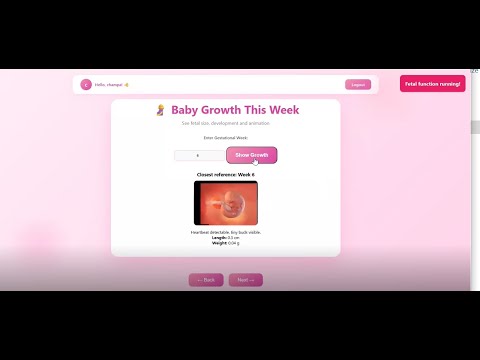
4. To implement a fetal development tracker that provides week-wise growth, physical milestones, and informative visual feedback.
This enhances maternal awareness and emotional engagement during pregnancy.
5. To create a comprehensive web platform with alerts, reminders, gamification, and secure user authentication.
This objective ensures continuous monitoring, improved adherence, and a user-friendly pregnancy support system.
Block Diagram