Abstract
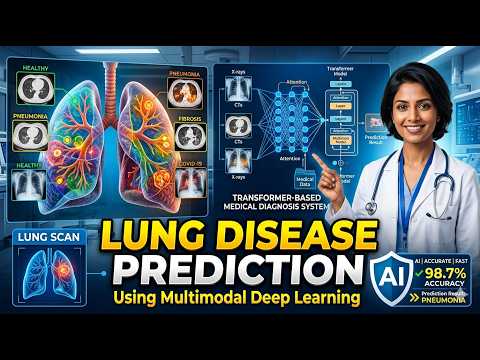
This project proposes a multimodal deep learning framework for the classification of lung diseases by integrating chest X-ray images with patient clinical data. The system utilizes a deep convolutional neural network to extract meaningful visual features from medical images, while a transformer-based model processes clinical parameters such as age, fever, cough, and oxygen saturation. These heterogeneous features are combined using a feature fusion technique to form a unified representation, which is then used for classification.
The proposed model is capable of identifying lung diseases including COVID-19, Normal, Pneumonia, and Tuberculosis with high accuracy. The integration of both image and clinical data enhances the model’s ability to make context-aware predictions, improving reliability compared to traditional single-modality approaches. The system is deployed using a web-based application that allows users to upload images, enter clinical details, and receive real-time predictions along with confidence scores.
Overall, the proposed system provides an efficient, accurate, and scalable solution for assisting healthcare professionals in early lung disease detection and decision-making.
Keywords
Multimodal Deep Learning, Lung Disease Classification, Medical Image Analysis, Clinical Data Fusion, Deep Neural Networks, Healthcare AI, Disease Prediction, Web-Based System
Introduction
Lung diseases are among the leading causes of mortality worldwide and continue to pose serious challenges to healthcare systems. Conditions such as COVID-19, pneumonia, and tuberculosis affect millions of individuals every year, making early detection and accurate diagnosis critically important. Timely identification of these diseases can significantly improve patient outcomes, reduce complications, and support effective treatment planning. However, traditional diagnostic approaches often rely on manual analysis of medical images and clinical judgment by healthcare professionals, which can be time-consuming, subjective, and dependent on the availability of experienced specialists.
Medical imaging techniques, particularly chest X-rays, play a vital role in diagnosing lung-related conditions. These images provide valuable insights into lung structure and help identify abnormalities such as infections, inflammations, and lesions. Despite their importance, interpreting these images accurately requires expertise, and errors may occur due to human limitations or variations in judgment. In regions with limited medical resources, the shortage of trained radiologists further complicates the diagnostic process, highlighting the need for automated and intelligent systems that can assist in decision-making.
In recent years, advancements in artificial intelligence and deep learning have significantly improved the field of medical image analysis. Convolutional Neural Networks (CNNs) have proven highly effective in extracting meaningful features from images and performing classification tasks with high accuracy. These models can automatically learn complex patterns from large datasets, reducing the need for manual feature engineering. As a result, deep learning-based systems have been widely adopted for disease detection and classification in healthcare applications.
However, most existing systems rely solely on image-based analysis and do not consider important clinical parameters such as patient age, symptoms (fever, cough), and oxygen saturation levels. These clinical factors provide essential contextual information that complements imaging data and plays a crucial role in accurate diagnosis. Ignoring such information can lead to incomplete analysis and reduced prediction reliability, especially in cases where visual features alone are insufficient.
To overcome these limitations, the concept of multimodal learning has gained attention in recent years. Multimodal learning involves integrating data from multiple sources to improve system performance and provide a more comprehensive understanding of the problem. In the context of lung disease prediction, combining chest X-ray images with clinical data enables the system to analyze both visual patterns and patient-specific information simultaneously. This integrated approach enhances the model’s ability to make accurate and context-aware predictions.
In this project, a multimodal deep learning framework is proposed for lung disease classification. The system combines image-based feature extraction with clinical data processing to create a unified representation for classification. By leveraging advanced deep learning techniques, the system aims to improve diagnostic accuracy and provide reliable predictions. Additionally, the system is implemented through a web-based interface, allowing users to upload images, enter clinical details, and obtain real-time results. This makes the solution practical and accessible for real-world healthcare applications.
Overall, the proposed approach addresses the limitations of traditional diagnostic methods by integrating multiple data sources and automating the classification process. It has the potential to support healthcare professionals in early disease detection, reduce diagnostic errors, and improve the efficiency of medical decision-making systems.
Block Diagram