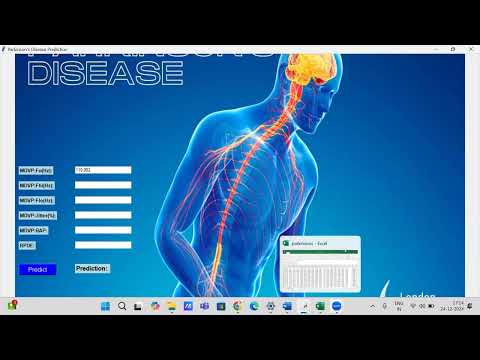
This project demonstrates the implementation and comparison of multiple machine learning models for the classification task of predicting Parkinson's disease status using a set of features extracted from voice recordings. The dataset used contains various voice features such as jitter, fundamental frequency, and relative average perturbation (RPDE). Four different classification models are trained and evaluated: Decision Tree (DT), Random Forest (RF), XGBoost (XGB), and K-Nearest Neighbors (KNN). The workflow begins with the preprocessing and selection of relevant features and target variable. The dataset is then split into training and testing subsets to evaluate model performance. Each model is trained using the training data and tested on the test data, followed by calculating the accuracy of each model. The models are then saved for future use, and their performance is compared using a bar chart visualization.The Decision Tree model, Random Forest model, XGBoost model, and K-Nearest Neighbors model are evaluated for classification accuracy. The resulting comparison of training accuracies helps determine which model performs the best for this specific task. All models are saved using the `joblib` library for future use. This approach provides a comprehensive way of training multiple models, evaluating their performance, and visualizing the results to make an informed decision about which model to deploy. The Python libraries used include Scikit-learn for model training and evaluation, XGBoost for advanced boosting algorithms, and Matplotlib for visualizing the results.Decision Tree (DT): 93.3%, Random Forest (RF): 96.4%, XGBoost (XGB): 96.8%, K-Nearest Neighbors (KNN): 92.1%. Based on these accuracy results, the XGBoost model achieved the highest accuracy of 96.8%, followed closely by the Random Forest model at 96.4%, showing excellent performance for predicting Parkinson's disease status. The models are saved using the joblib library for future deployment. This approach provides a comprehensive way to train, evaluate, and compare models, ultimately helping in the decision-making process for deploying the most effective model in a clinical or diagnostic setting
Block Diagram
Parkinson’s disease (PD) is a progressive neurodegenerative disorder that primarily affects the motor system. It is caused by the gradual degeneration of dopamine-producing neurons in the brain, leading to symptoms such as tremors, rigidity, bradykinesia (slowness of movement), and postural instability. Although Parkinson’s disease is commonly associated with older adults, it can affect individuals of all ages. Early detection and accurate diagnosis are critical for managing the disease and improving the quality of life of affected individuals. Traditionally, Parkinson’s disease has been diagnosed through clinical evaluations, neurological tests, and imaging techniques. However, these methods are often time-consuming, expensive, and subjective.In recent years, advancements in machine learning (ML) have significantly improved the detection and diagnosis of various medical conditions, including Parkinson’s disease. Machine learning models, particularly those focused on pattern recognition and classification, have proven to be effective in detecting Parkinson’s disease at an early stage. By analyzing complex datasets such as medical records, imaging data, and even voice recordings, machine learning algorithms can identify patterns indicative of Parkinson’s disease that may not be immediately apparent through traditional diagnostic methods.This paper explores the role of machine learning in Parkinson’s disease detection, focusing on how various machine learning techniques can be applied to predict the presence of the disease based on physiological and behavioral data. Specifically, we will examine the use of voice features, including vocal frequency and variability, as indicators of Parkinson’s disease and how models like Decision Trees, Random Forests, XGBoost, and K-Nearest Neighbors can be trained to distinguish between healthy individuals and those with Parkinson’s.
Software Requirements:
1. Python 3.8
Hardware Requirements:
1. PC or Laptop
*order from online
Leave a Review
Only logged-in users can leave a review.
Customer Reviews
No reviews yet. Be the first to review this product!